



| IN A NUTSHELL |
|
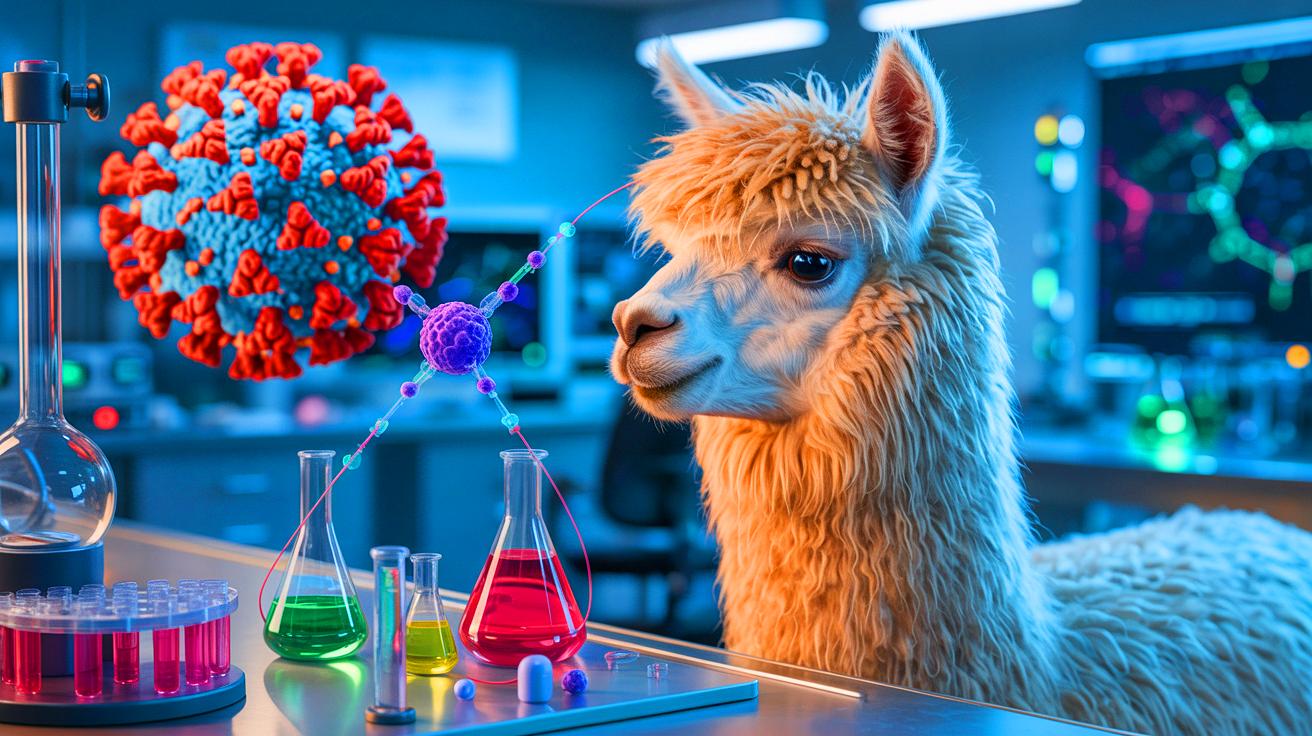
In a recent breakthrough, researchers have identified a potential weapon against two deadly viruses, Hendra and Nipah, which have long posed significant health threats. These viruses, originating from bats, can cause serious respiratory and neurological issues in humans. A small yet powerful nanobody, named DS90, was discovered by a team from The University of Queensland. This nanobody, derived from an alpaca’s immune system, offers hope for new treatments. The unique properties of nanobodies, including their small size and stability, allow them to access parts of a virus that conventional antibodies cannot, making them a promising tool in the fight against these dangerous pathogens.
The Science Behind DS90
DS90 emerged from a sophisticated platform created by Professor Alejandro Rojas-Fernandez at the Universidad Austral de Chile. This platform enabled the isolation of DS90 from the immune cells of an alpaca named Pedro. Researchers developed an extensive library of potential nanobodies, employing advanced screening techniques to identify the most effective candidates. DS90 stood out due to its exceptional binding capabilities.
The University of Queensland team utilized cryogenic electron microscopy to study DS90’s interaction with viral proteins. Professor Daniel Watterson explained that this technology allowed them to observe DS90 binding to virus proteins, reaching into deep pockets that ordinary antibodies cannot access. This binding is critical, as it prevents the virus from entering human cells, thereby halting its replication and the onset of illness.
The research demonstrated DS90’s remarkable binding strength, with a dissociation constant of 4.83 nanomolar against the Nipah F protein. Furthermore, DS90 exhibited the ability to neutralize various strains of both Nipah and Hendra viruses, with a half-maximal inhibitory concentration in the picomolar range, indicating its potent efficacy.
Combining Forces Against Viral Escape
Viruses such as Nipah and Hendra are known for their rapid mutation rates, which enable them to evade treatments by altering their surface proteins. This mutability has often rendered antibody treatments ineffective over time, as observed in the evolution of COVID-19 variants. To address this challenge, researchers combined DS90 with another antibody, m102.4, which targets a different viral protein known as the receptor-binding protein (RBP).
Developed at The University of Queensland, m102.4 has already undergone testing in animal models. By combining DS90 and m102.4, scientists created a bispecific antibody capable of targeting two viral proteins simultaneously. Dr. Ariel Isaacs noted that this dual-targeting strategy prevents the Nipah virus from mutating and evolving to escape treatment.
This innovative approach effectively blocks potential viral escape routes. Even if the virus mutates one protein, the other binding site remains obstructed. Bispecific antibodies offer additional advantages, including cost-effective production compared to antibody cocktails and simplified storage and administration, as they are delivered as a single molecule.
From Alpacas to People
The discovery of DS90 began with Pedro the alpaca’s immune response to viral components. Scientists harnessed his immune cells to create a library of nanobodies. Using bacterial display techniques, they screened millions of nanobody candidates, with DS90 emerging as a standout due to its strength and stability.
Professor Rojas-Fernandez emphasized the collaborative effort with The University of Queensland to establish a broad defense against potential pandemic viruses using scalable antiviral nanobodies. This groundbreaking work represents a significant step forward in nanobody-based antiviral therapies.
Advanced electron microscopy revealed DS90’s unique ability to bind to a glycan-free site on the virus’s fusion protein. Its distinctive shape allows it to penetrate deep quaternary pockets, unlike conventional antibodies that adhere only to exposed surfaces. DS90’s CDR2 and CDR3 regions form robust hydrogen bonds, securing its attachment.
Intriguingly, DS90’s binding alters the conformation of viral protein components, further stabilizing them and preventing fusion with human cells. Additionally, it mimics certain aspects of the virus’s fusion peptide, disrupting viral particle assembly and infection.
What Lies Ahead
The study demonstrated DS90’s ability to neutralize multiple strains of Nipah and Hendra, including those with mutations resistant to other treatments. This broad-spectrum activity is crucial given the frequent mutations observed in henipaviruses, akin to many RNA viruses.
Dr. Isaacs highlighted the potential of nanobodies, noting that some have already been approved for cancer treatments. The success of DS90 signifies a promising advancement in using nanobodies to combat viral threats.
Professor Watterson emphasized that this research marks a pivotal step toward developing a nanobody-based treatment for Hendra and Nipah, which pose ongoing risks, particularly in Australia and Asia. The next phase involves translating these findings into a practical therapy, ideally suited for deployment during outbreaks.
The research team, comprising scientists from Universidad Austral de Chile, CSIRO’s Australian Centre for Disease Preparedness, and the University of Science and Technology of China, exemplifies the power of international collaboration in accelerating the fight against deadly viruses.
This discovery heralds a new era for nanobody-based treatments. Their small size, stability, and ease of production position them as key players in preventing future pandemics. DS90’s success in targeting concealed viral sites underscores the potential of bispecific antibodies in antiviral therapies. By simultaneously blocking two viral proteins, such treatments can maintain efficacy despite viral mutations. As Professor Rojas-Fernandez aptly put it, “This is just the beginning.” What other innovative solutions might emerge from this promising field of research?