



| IN A NUTSHELL |
|
In recent years, the intersection of quantum physics and general relativity has become a focal point for scientists aiming to unlock the mysteries of the universe. While quantum physics deals with the behavior of the smallest particles, general relativity explains how gravity shapes the cosmos. Despite numerous experiments confirming each theory independently, how they interact remains one of science’s greatest enigmas. Now, breakthroughs in quantum networking provide a new frontier to explore this interaction, potentially transforming our understanding of the universe at its most fundamental level.
The Power of Quantum Networks
Quantum networking is emerging as a revolutionary technology with the potential to redefine the landscape of communication and computation. A global quantum internet would enable ultra-secure communication and connect quantum computers worldwide, revolutionizing data security and processing capabilities. However, beyond these practical applications, quantum networks hold the promise of addressing fundamental questions about the universe.
A team of physicists, including Igor Pikovski from Stevens Institute of Technology, Jacob Covey from the University of Illinois at Urbana-Champaign, and Johannes Borregaard at Harvard University, has been exploring how quantum networks can probe the fabric of spacetime. Their research, published in the journal PRX Quantum, describes how these networks can be utilized to test the principles of curved spacetime as described by Einstein’s general relativity.
This convergence of quantum networks and curved spacetime may finally offer insights into how gravity affects quantum systems, setting the stage for groundbreaking discoveries.
Superpositions and Spacetime
Central to this exploration is the quantum principle of superposition, where particles can exist in multiple states simultaneously. In quantum computing, this principle is harnessed to perform powerful calculations, extending the capabilities of traditional computers. When these quantum systems encounter areas influenced by curved spacetime, as predicted by general relativity, intriguing phenomena occur.
General relativity posits that gravity is not merely a force but a curvature of space and time caused by massive objects. This curvature affects the flow of time, slowing it down in the presence of massive bodies like planets. This effect, famously depicted in the film Interstellar, raises the question: what happens when a quantum system in superposition experiences this alteration in time?
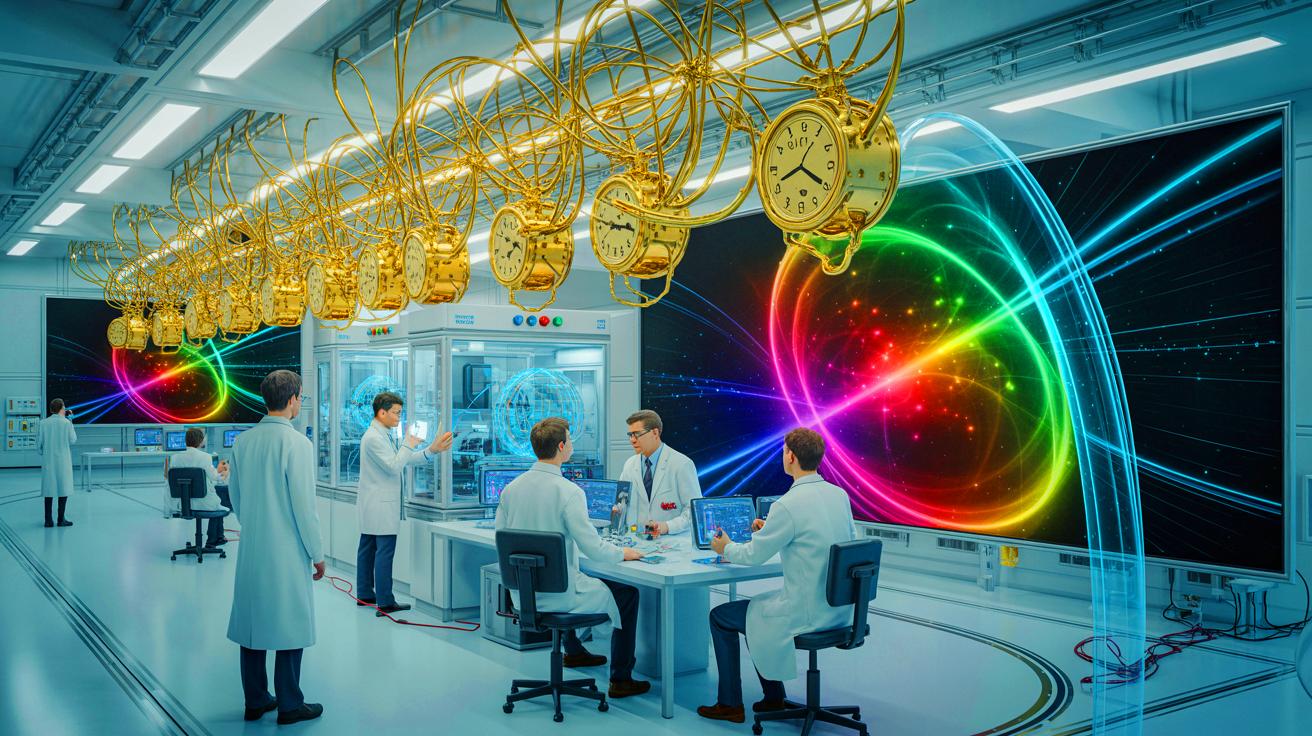
Pikovski and his colleagues are investigating these scenarios by utilizing quantum networks. These networks allow entangled atomic clocks to experience multiple time flows simultaneously, a feat previously untestable but now feasible with advancements in quantum technology.
“We assume that quantum theory holds everywhere, but we really don’t know if this is true,” Pikovski notes, pointing to the potential for gravity to alter the workings of quantum mechanics.
Building the Experiment
To translate theoretical models into practical experiments, the research team collaborated with Covey’s laboratory. They developed a protocol enabling quantum clocks to be connected through networks, sharing quantum information. This method employs entangled W-states, where multiple qubits are interconnected, allowing instantaneous changes across the system.
By leveraging quantum teleportation, the researchers transferred the quantum state of a particle to another without physical movement. This, combined with Bell pairs, maximally entangled qubits, formed a robust framework for testing fundamental physics. These experiments allow scientists to observe the subtle time changes induced by Earth’s gravity while maintaining the quantum entanglement of the clocks.
This approach doesn’t merely test established physics; it ventures into the unknown, challenging the boundaries of current scientific understanding.
A New Frontier in Physics
The findings suggest that quantum networks can serve not only as communication or computational tools but also as sensitive instruments for probing deep physics questions. Traditional sensors or clocks lack the precision to measure time differences at the quantum level. However, quantum superpositions and entanglement open the door to measuring entirely new effects.
Pikovski emphasizes the significance of this work, stating, “The interplay between quantum theory and gravity is one of the most challenging problems in physics today, but also fascinating.” By integrating contemporary quantum technologies with Einstein’s cosmic insights, researchers are pioneering a new era of experiments that transcend theoretical musings and enter the realm of achievable science.
Looking Ahead
The journey towards a global quantum internet presents an opportunity to unravel longstanding scientific puzzles. While a comprehensive theory of quantum gravity remains elusive, recent developments highlight the tangible progress being made. These advancements signify a paradigm shift, where theoretical physics meets empirical validation.
A network of quantum-entangled clocks, distributed across vast distances, holds the potential to reveal the interactions between quantum mechanics and the curvature of spacetime predicted by Einstein. This could either validate our current understanding of physics or expose its limitations.
As we advance toward a future where quantum networks become a reality, the implications extend beyond technological innovation, offering profound insights into the fundamental nature of time, space, and reality itself.
As scientists continue to push the boundaries of what is possible, they invite us to ponder: how will these discoveries reshape our perception of the universe and our place within it?