



| IN A NUTSHELL |
|
In a groundbreaking study, scientists in Austria have developed a novel method to observe the formation of electric charge in real time, offering a fresh perspective on the elusive phenomenon of lightning. By employing a green laser and a tiny glass bead, this research sheds light on the intricate processes that occur at the microscopic level as particles become electrically charged. This scientific advancement not only revisits a century-old experiment but also pushes the boundaries of our understanding of atmospheric electricity, holding potential implications for storm prediction, air quality studies, and materials science.
The Moment the Charge Begins
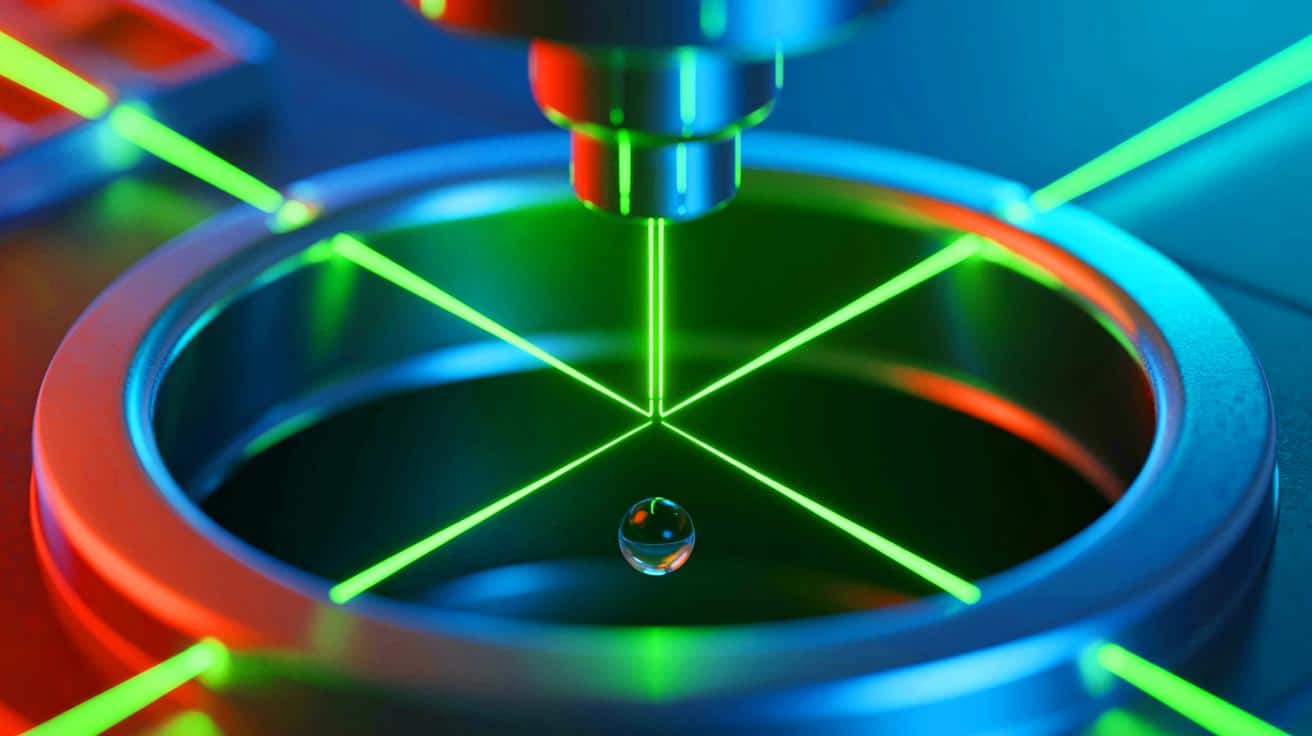
The innovative setup designed by the researchers is remarkable not only for its ability to trap a particle but also for its capacity to reveal the charging process itself. During their experiments, the team observed a silica bead slowly acquiring a positive charge when exposed to intense green light. Initially, the rate of charge accumulation was steady, but it gradually slowed over time. However, the charging process never completely halted, continuing to increase incrementally for hours.
This effect, as the researchers discovered, is the result of a two-photon process. When two light particles strike the silica simultaneously, they provide enough energy to dislodge a single electron, leaving behind a positive charge. This finding was a significant breakthrough for the team. Andrea Stöllner, a Ph.D. student involved in the research, expressed her excitement, stating, “The first time I caught a particle, I was over the moon.” With further refinements, they managed to sustain the particle’s position for weeks, allowing for detailed observations of its behavior under varying conditions.
“Our new setup allows us to explore the ice crystal theory by closely examining a particle’s charging dynamics over time,” said Stöllner.
The Hidden World Inside Glass
The source of electrons released during the charging process lies in the inherent defects within the silica glass. These imperfections create extra energy levels, akin to hidden steps on an energy ladder, enabling two photons to eject an electron. To validate this phenomenon, the researchers compared their laser-based observations with an established technique known as photoelectron yield spectroscopy. This method involves shining ultraviolet light on powdered silica and counting the electrons that escape.
The results from both approaches aligned closely, confirming the existence of a rich, unseen landscape of electronic states within the glass. Interestingly, the laser method even detected lower energy levels than previously identified, suggesting the presence of additional electronic states. While some uncertainties remain, such as the potential influence of heat on electron release, future experiments are expected to clarify these aspects and advance our understanding of the material’s behavior.
Experimental setup. The trapping laser (532 nm) is split into two beams by a polarizing beam splitter and coupled into single-mode optical fibers.
Why a Speck of Dust Matters
The implications of this research extend beyond laboratory experiments. Understanding the charging dynamics of particles is crucial for unraveling the mysteries of lightning initiation, a longstanding question in atmospheric science. Within clouds, ice crystals and aerosols engage in complex interactions, exchanging electric charges and gradually transforming storms into formidable electric engines. However, the precise mechanism that ignites the first lightning bolt remains elusive.
The new experimental setup provides a unique opportunity to explore the ice crystal theory in greater depth, potentially revealing how these particles contribute to the formation of lightning. As Stöllner suggests, the observed discharges in model ice crystals might represent the precursors to minuscule lightning sparks, challenging existing hypotheses and opening new avenues for research.
Beyond atmospheric phenomena, this technique could revolutionize the study of air pollution, cloud formation, and even disease transmission, as aerosols play a pivotal role in these processes. The ability to control and measure charge at the single-electron level offers valuable insights into the behavior of airborne particles and their impact on the environment.
Practical Implications of the Research
The potential applications of this research are far-reaching. In meteorology, it could enhance storm prediction models by providing a more accurate depiction of how lightning originates within clouds. In the realm of materials science, the method offers a novel approach to mapping electronic defects, aiding in the design of stronger glass and advanced optical devices.
Furthermore, the ability to manipulate charge at such a precise level may pave the way for advancements in sensor technology, microelectronics, and the study of airborne health risks. With the findings published in the journal Physical Review Letters, this research represents a significant step forward in multiple scientific domains, setting the stage for future discoveries.
Research findings are available online in the journal Physical Review Letters.
As this innovative research continues to unfold, it raises intriguing questions about the broader implications of understanding and manipulating electric charge. How might these findings reshape our approach to atmospheric science, materials engineering, and public health? Could they ultimately lead to new technologies or methodologies that enhance our ability to predict and mitigate natural phenomena? The pursuit of answers to these questions promises to be as enlightening as the initial discoveries themselves.