



| IN A NUTSHELL |
|
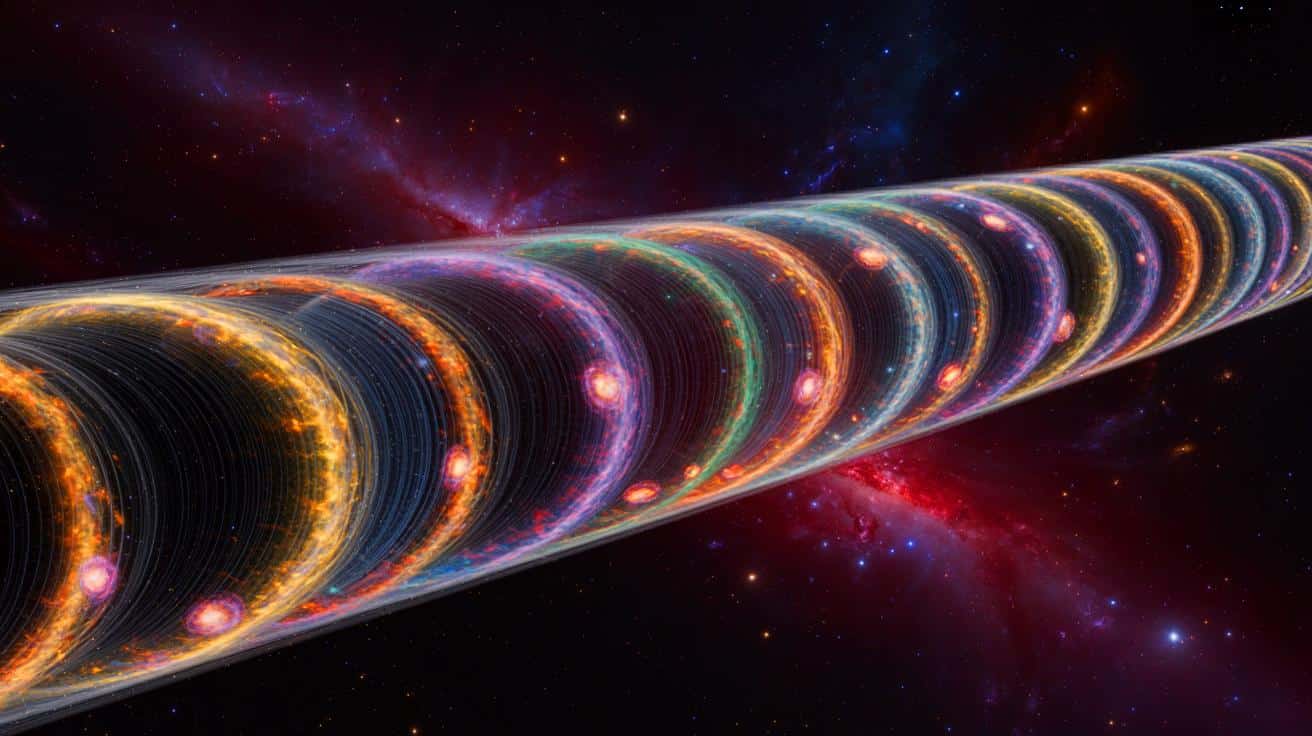
In a groundbreaking discovery, scientists have identified a cosmic structure stretching 50 million light-years, revealing insights into the vast interconnected web of the universe. Unlike the random scattering of stars in the night sky, these massive filaments demonstrate a highly organized system where galaxies align and rotate in unison. This research, led by a team from the University of Oxford, offers a clearer understanding of the cosmic highways that not only guide the movement of matter but also influence the spin and formation of galaxies. As the universe’s intricate design unfolds, it challenges existing models and offers a new perspective on the evolution of cosmic structures.
The Discovery of a Cosmic Filament
The journey to uncover this vast cosmic filament began in the Karoo region of South Africa, home to the MeerKAT radio telescope. This array of 64 white dishes listens for faint signals from space, particularly those emitted by atomic hydrogen, the universe’s most abundant element. By analyzing data from the MIGHTEE project, researchers focused on a well-known region in the sky called COSMOS. Here, they identified a peculiar alignment: 14 galaxies rich in hydrogen gas arranged in a narrow line, stretching approximately 5.5 million light-years.
What made this discovery exceptional was the galaxies’ synchronized motion. All were moving at nearly the same speed, forming a coherent chain that stood out against the backdrop of the universe. To gain a more complete picture, the team turned to optical data from the Sloan Digital Sky Survey and the Dark Energy Spectroscopic Instrument. This allowed them to expand their view and identify a larger filament with over 280 galaxies, spanning roughly 50 million light-years. Within this grand structure, the narrow hydrogen line appeared as a bright, distinct feature.
A Cosmic Ride with a Shared Spin
The real surprise emerged when researchers analyzed the rotation of these galaxies. Like planets and stars, galaxies rotate, and their spin is thought to originate from subtle forces in the early universe. By examining the shapes and angles of the galaxies in optical images, scientists determined that most of them rotated in the same direction as the surrounding filament. This finding is akin to a theme park ride, where individual teacups spin while the entire platform rotates.
Additionally, the team investigated whether the filament itself exhibited bulk rotation. By measuring galaxy speeds on either side of the filament’s center, they found a pattern consistent with slow rotation around its length. This motion is estimated at about 68 miles per second, offering a tangible example of a large-scale cosmic structure in motion. The combination of individual galaxy spins and the filament’s rotation presents a unique cosmic phenomenon, challenging current cosmological models.
Young and Rich in Fuel
This filament is characterized as “dynamically cold,” indicating a relatively undisturbed state with minimal chaotic motion. The galaxies within it contain substantial hydrogen reserves, suggesting they are young and not heavily influenced by collisions or gravitational interactions. According to Dr. Madalina Tudorache of the University of Cambridge and Oxford, such systems act as fossil records of cosmic flows, helping scientists understand how galaxies acquire their spin over time.
The presence of hydrogen along the filament highlights ongoing matter inflow, feeding galaxies and facilitating star formation. Interestingly, the study also observed variations in galaxy behavior along the filament. In denser regions, where galaxies are closely packed, their spins become disordered. Conversely, in quieter stretches, alignment remains strong, hinting at the impact of interactions and mergers on cosmic structures.
A Challenge for Cosmological Models
The sharp alignment observed in this study surpasses predictions from most computer models, suggesting that cosmic filaments may exert a greater influence on galaxy spin than previously thought. This carries implications for future observations of dark matter and dark energy. As upcoming missions like the European Space Agency’s Euclid spacecraft and the Vera C. Rubin Observatory aim to study gravitational lensing, understanding natural galaxy alignments becomes crucial.
Galaxy alignments can mimic weak lensing signals, potentially skewing results if not accounted for. As Dr. Lyla Jung from Oxford explains, “Strong alignments like this can mimic the effect we use to map dark matter. If we do not account for them, results could be skewed.” This research underscores the importance of integrating data from multiple observatories to gain a comprehensive view of the universe.
Practical Implications of the Research
Unraveling the mechanisms by which galaxies gain their spin aids in understanding the flow of matter across cosmic scales. This knowledge refines models of galaxy formation and evolution, enhancing predictions about star birth and development. Moreover, the discovery informs planning for future missions that probe dark matter and dark energy. By recognizing how natural alignments influence measurements, scientists can refine their tools and avoid misinterpretations.
On a broader level, this research highlights the interconnectedness of cosmic systems. Filaments not only anchor galaxies but also shape their movement, lifecycle, and history. This insight advances our comprehension of how the universe evolved into a place capable of supporting stars, planets, and eventually life. As we continue to explore these cosmic threads, what new secrets might they reveal about our place in the universe?



Wow, a 50-million-light-year structure? That’s mind-blowing! 🌌
Wow, 50 million light-years! That’s a long commute. 🚀
This is mind-blowing! Can anyone explain how they measure such vast distances?
Are there any implications for dark matter research from this discovery?
Great article! Thanks for sharing these insights.
I love learning about stuff like this; it makes me feel so small and insignificant. 😂
Does this change our understanding of the Big Bang theory?
Can someone explain how galaxy “spin” works? I’m a bit confused. 🤔
Incredible discovery! The universe never ceases to amaze. 🌌
I’m skeptical about these findings. How can we be sure about the data?
Did this study use AI technologies to analyze the data? Curious about the methods!
What exactly is a “dynamically cold” filament?
Isn’t this just another theory? How can we be sure it’s accurate?
Thank you for such an informative read. More science articles, please!