




| IN A NUTSHELL |
|
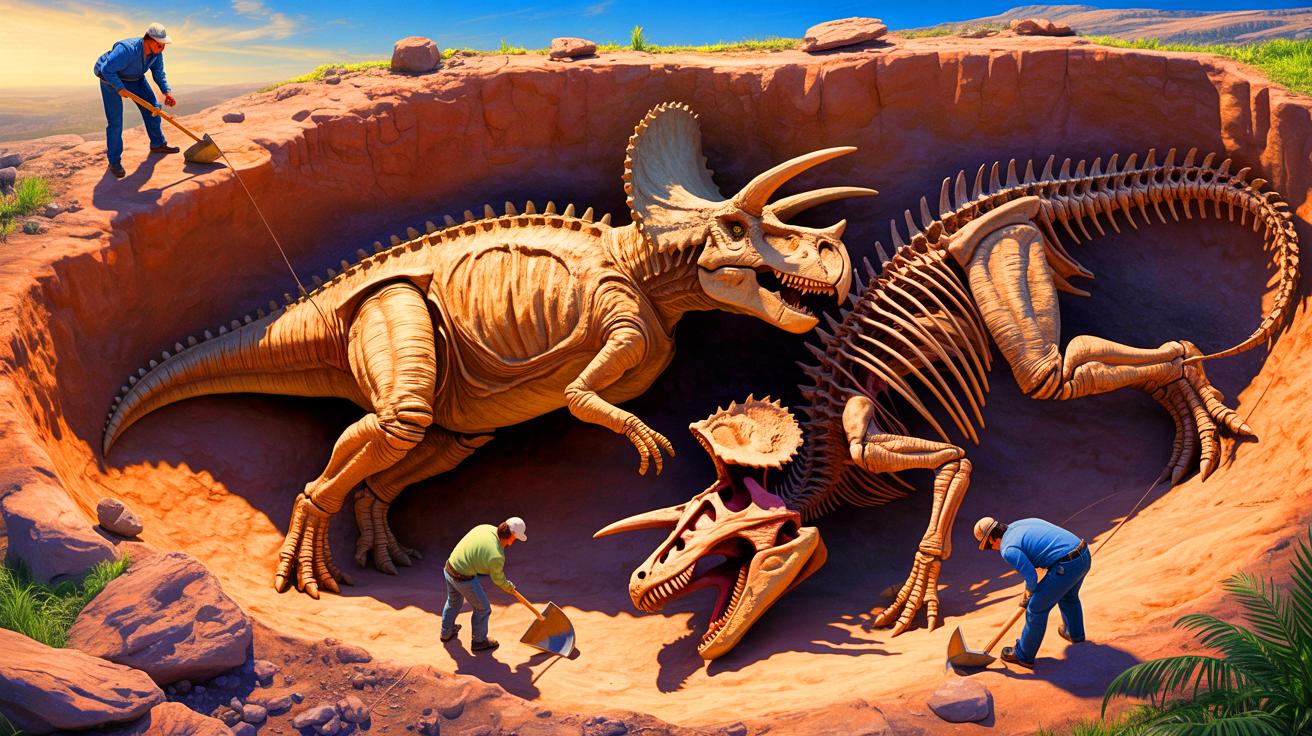
A groundbreaking discovery in paleontology has resolved a long-standing debate over the existence of a smaller relative of the Tyrannosaurus rex. The “Dueling Dinosaurs” fossil, unearthed in Montana’s Hell Creek Formation, has provided definitive evidence that the smaller tyrannosaur fossils, once thought to be juvenile T. rexes, actually represent a distinct species known as Nanotyrannus lancensis. This revelation not only challenges previous assumptions but also reshapes our understanding of the ecosystem dynamics during the Cretaceous period. The discovery underscores the importance of revisiting established scientific theories with fresh perspectives and highlights the dynamic nature of paleontological research.
The Fossil That Started a Scientific Storm
The origins of this scientific controversy trace back nearly 80 years, when a small tyrannosaur skull was discovered in Montana. Initially named Gorgosaurus lancensis, it was later reclassified as Nanotyrannus lancensis, presumed to be a smaller cousin of the T. rex. However, the paleontological community was divided. Some researchers insisted these fossils were merely juvenile T. rexes, while others believed they represented a separate species.
In 2001, the debate intensified with the discovery of a nearly complete skeleton named “Jane,” which resembled the earlier skull. Histological studies confirmed that Jane was still growing, leading many to conclude that Nanotyrannus specimens were juvenile T. rexes. This consensus influenced educational materials and museum exhibits for years. Yet, a minority of scientists argued that the anatomical differences were too significant to be explained by growth alone, setting the stage for further investigation.
The Nature of the Research-Team Investigation
An extensive re-examination of the Dueling Dinosaurs fossil by a team led by Dr. Lindsay Zanno and James Napoli provided crucial insights. Their research involved a comprehensive histological analysis of the bones, revealing growth rings and other indicators of physical maturity. The findings conclusively demonstrated that the specimen was a fully grown adult, approximately 20 years old, challenging the notion of it being a juvenile T. rex.
The anatomical differences were striking. Nanotyrannus had more elongated forelimbs, more teeth, and a significantly smaller body size compared to T. rex. These features, along with variations in the skull and tail, confirmed that Nanotyrannus was not a juvenile T. rex but a distinct species. The investigation also highlighted the importance of examining privately owned fossils to ensure scientific accuracy and transparency.
A Forgotten Predator Rediscovered
In the course of their research, Zanno and Napoli identified another distinct individual, naming it Nanotyrannus lethaeus, after the River Lethe from Greek mythology. This discovery suggests that multiple tyrannosaur species coexisted in North America’s ancient floodplains during the Cretaceous period. The findings challenge the long-held belief that T. rex was the sole apex predator of its time.
Dr. Zanno remarked, “This discovery paints a richer, more competitive picture of the last days of the dinosaurs.” The presence of the agile Nanotyrannus alongside the massive T. rex indicates a more complex and competitive ecosystem than previously understood. This newfound diversity among tyrannosaurs offers a fresh perspective on predator-prey dynamics and ecological interactions during the Cretaceous.
How Science Went Wrong
The study raises important questions about scientific consensus and the potential pitfalls of groupthink. For decades, the assumption that all small tyrannosaur fossils were juvenile T. rexes went largely unchallenged. This simplistic explanation provided a convenient solution to the scarcity of juvenile T. rex fossils in the record. However, this case illustrates that science thrives on challenging established norms and questioning accepted views.
Restricted access to privately owned fossils and academic hierarchies may have contributed to the persistence of outdated theories. The public display of the Dueling Dinosaurs specimens at the North Carolina Museum of Natural Sciences allows for open scientific inquiry and public engagement. This approach ensures that research is conducted with transparency, fostering a more accurate understanding of prehistoric life.
Revising the Map of Prehistoric Life
The acceptance of Nanotyrannus as a distinct species necessitates a reevaluation of late Cretaceous ecosystems. The discovery highlights the diversity and complexity of predator interactions in North America, suggesting that prior research using Nanotyrannus fossils as proxies for T. rex behavior must be reconsidered.
“This changes everything about how we understand tyrannosaur evolution,” Zanno emphasized. The discovery of a separate branch of the tyrannosaur family tree underscores the value of patience and thorough analysis in scientific research. Zanno and Napoli’s meticulous approach serves as a testament to the enduring relevance and excitement of paleontological discovery.
As we continue to unravel the mysteries of our planet’s ancient past, new questions arise about the ecosystems that existed millions of years ago. What other undiscovered species might still be hidden within the fossil record, waiting to reshape our understanding of prehistoric life? The answers may hold the key to further revelations about the history of life on Earth.