



| IN A NUTSHELL |
|
In the realm of astrophysics, black holes have long been enigmatic entities, challenging our understanding of the universe. Though they appear distant and abstract, new high-resolution images of black hole shadows are bringing us closer to answering profound questions about gravity and the nature of space-time. These images illuminate the swirling rings of gas surrounding black holes, offering insights into one of the universe’s most compelling phenomena. As scientists delve deeper into these cosmic giants, the potential to test and perhaps even challenge Einstein’s theory of general relativity grows ever more exciting.
Looking at Gravity Where It Pushes Its Limits
For over a century, general relativity has been the cornerstone of our understanding of space and time. Its predictions about the curvature of space-time around massive objects have stood the test of time. One of these predictions is the formation of black holes when matter collapses under its own gravitational pull. However, most confirmations of relativity come from relatively tame environments like our Solar System.
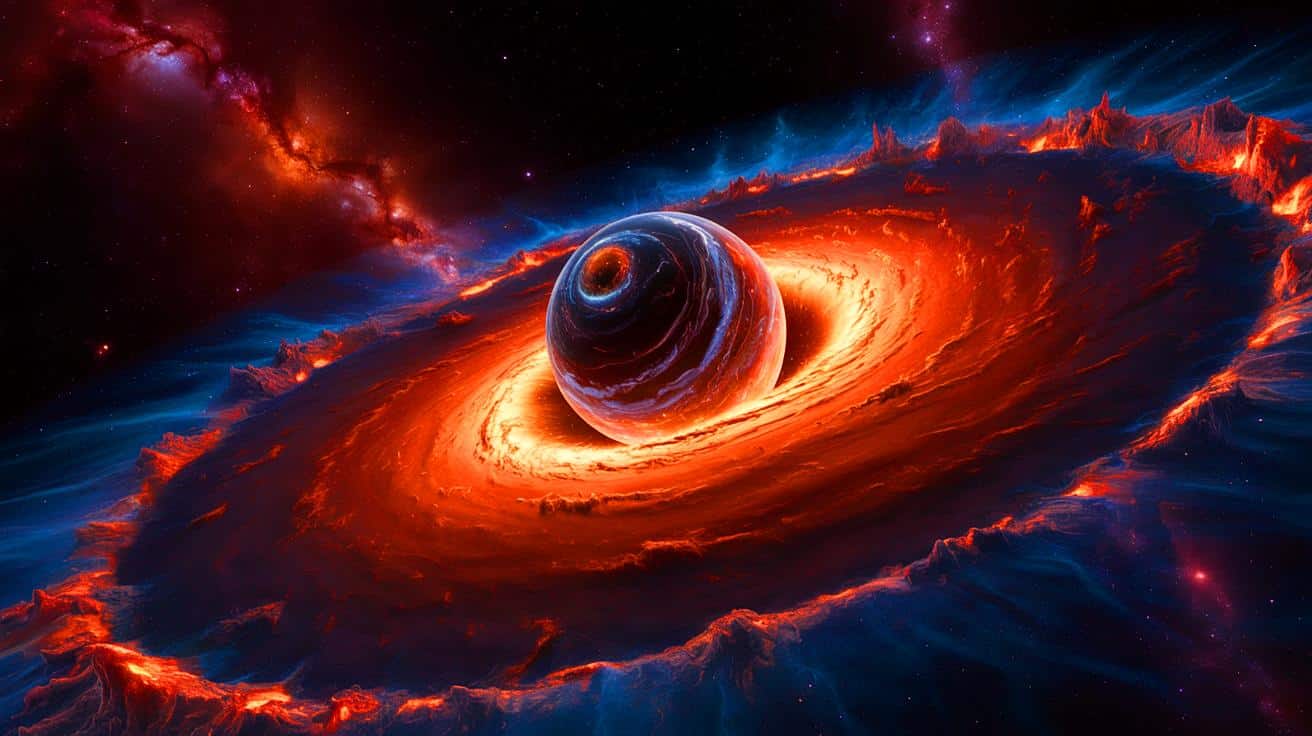
Black holes provide a unique opportunity because their immense gravity creates conditions unlike any other. The edge of a black hole, known as the event horizon, is a boundary beyond which nothing can escape. This makes it an ideal testing ground for theories of gravity. The Event Horizon Telescope’s release of the first shadow images has sparked new hope for testing gravity in ways that were once deemed impossible. As Prof. Luciano Rezzolla from Goethe University Frankfurt explains, the images reveal not the black hole itself but the hot matter in its vicinity. This matter emits a final flash of light before disappearing into the void, creating a bright ring that researchers are keen to analyze further.
How Scientists Compare Black Hole Shadows
Researchers from Frankfurt and the Tsung-Dao Lee Institute in Shanghai have embarked on a journey to explore alternatives to Einstein’s predictions. By running detailed simulations, they have studied how plasma and magnetic fields behave around various hypothetical black holes. These simulations have allowed them to trace light paths and create synthetic images based on different gravitational models.
The goal is to compare these synthetic images to the shadow produced by a standard Kerr black hole, which aligns with general relativity. By examining the shape, size, and brightness patterns of these models, researchers aim to identify discrepancies. If a model deviates from Einstein’s version by more than 2 to 5 percent, future telescopes should be able to detect these differences. This breakthrough sets a new benchmark for the precision needed to test competing theories, although current telescope technology has yet to achieve this level of clarity. Nevertheless, researchers remain optimistic that advancements in Earth-based and space-based observatories will soon make this possible.
Why a Few Percent Matters
Detecting even a small deviation in a black hole’s shadow could have far-reaching implications for physics. A difference of just a few percent might suggest that space behaves differently near a black hole or point to the existence of exotic matter. It could also challenge the physical laws we currently consider immutable. Conversely, if observations align perfectly with Einstein’s predictions, it would further bolster a theory that has withstood numerous tests.
While extreme possibilities like wormholes and naked singularities have been ruled out, measurement uncertainties still leave room for doubt. Scientists are eager to obtain sharper and cleaner images to draw more definitive conclusions. As Prof. Rezzolla notes, continually testing even established theories is crucial, especially when examining extreme objects like black holes.
The Challenges That Remain
Utilizing black holes as tools to test gravity is fraught with challenges. The environment near the event horizon is dynamic, with plasma moving and heating at incredible speeds. These fluctuations can obscure the subtle clues scientists seek. Achieving the necessary resolution is another hurdle, akin to spotting a coin on the Moon from Earth.
Noise, calibration difficulties, and plasma fluctuations can blur the images. To combat these issues, researchers are developing better algorithms to reconstruct images with less distortion. They also plan to observe black holes across different wavelengths and over multiple days to reduce uncertainty. Space-based telescopes, positioned far from Earth, could provide sharper images by increasing the distance between observation points. If successful, astronomers could measure the shadow’s radius with high accuracy, testing a range of gravity models.
The Road Ahead
The future of black hole research is promising, with new observatories poised to enhance existing radio telescope systems. Each improvement in sensitivity, calibration, and coverage brings sharper images of black holes. As these images improve, they may provide unprecedented evidence regarding whether gravity conforms to or diverges from Einstein’s theory.
This quest challenges scientists and invites curiosity about the universe’s fundamental rules. While a black hole’s shadow may initially appear as an empty circle of darkness, it holds the potential to unveil new truths about the cosmos. As researchers continue to explore these mysteries, what new insights will these cosmic shadows reveal about the nature of our universe?