



| IN A NUTSHELL |
|
In an age where technological advances continually redefine the boundaries of human understanding, a new breakthrough in quantum technology holds the potential to revolutionize multiple fields. Scientists have discovered the ability to harness and control tiny particles known as plasmons, which can confine electromagnetic energy into minuscule spaces. This groundbreaking discovery, led by Assistant Professor Aakash Sahai from the University of Colorado Denver, could dramatically alter the landscape of physics, medicine, and beyond. By scaling down particle accelerators to the size of a silicon chip, this innovation promises to open up new avenues of research and practical applications.
Unlocking the Power of Plasmons
At the core of this revolutionary discovery are plasmons, specifically “extreme plasmons,” which are distinct in their vigorous electron vibrations. Unlike typical plasmons with gentle oscillations, extreme plasmons vibrate with intense force, reaching the physical limits of electron movement. This results in electromagnetic fields that measure in the petavolt-per-meter range, a magnitude far surpassing what was previously achievable in laboratory settings.
Until now, controlling these intense plasmons posed significant challenges. However, Assistant Professor Aakash Sahai and his team have successfully developed a quantum kinetic model to harness these forces safely and predictably. Their work, highlighted in the journal Advanced Quantum Technologies, marks a significant turning point for experimental physics. Sahai asserts that this technology could have a direct impact on the world, akin to past breakthroughs like the development of lasers and computer chips. The implications of this discovery, grounded in material science, are vast and varied, promising to usher in new fields of study.
How It Works: Extreme Fields on a Tiny Chip
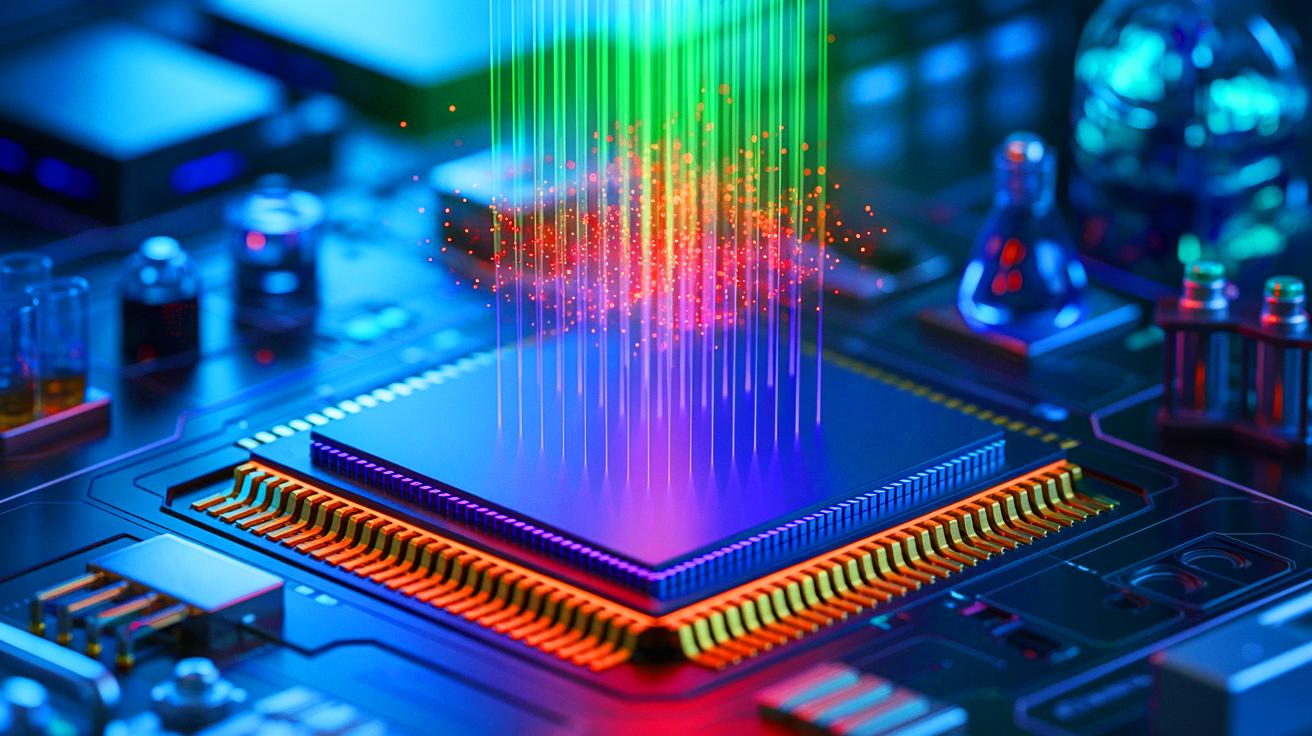
The conventional approach to studying powerful electromagnetic fields involves using large, expensive particle accelerators, such as CERN’s 17-mile-long Large Hadron Collider. Sahai’s discovery aims to condense the functions of these massive machines into a silicon chip no larger than a thumb. This is achieved through a special silicon-based material capable of withstanding the intense energy of high-speed particle beams.
As the beams pass through, electrons vibrate vigorously in a collective wave known as a “surface crunch-in plasmon.” This phenomenon compresses electron waves into extremely small areas, just a few tens of nanometers across. Sahai’s quantum kinetic model accurately predicts how these electrons move and the energy they produce. The ability to manipulate such high energy flow while preserving the material’s structure represents a significant technological breakthrough. This innovation holds the promise of making a real change in the world, as it enables a deeper understanding of nature and its potential applications.
From Gamma Ray Lasers to Multiverses
The potential applications of this breakthrough extend beyond current scientific limits, opening up possibilities that were once confined to the realm of science fiction. One exciting application is the development of gamma ray lasers, which could revolutionize medical treatments. Unlike traditional lasers, gamma ray lasers could target and eliminate cancer cells without damaging healthy tissue, offering a new approach to cancer treatment.
Moreover, this technology could enhance our understanding of diseases by allowing doctors to view cellular activity down to the atomic nucleus level. Beyond medical applications, extreme plasmons could also address fundamental questions about the universe itself. By recreating conditions previously attainable only with large particle accelerators, scientists can test theories about dark matter, vacuum polarization, and even multiverse existence. This capability might confirm or challenge groundbreaking theories, potentially reshaping our understanding of the universe.
What’s Next for Quantum Technology?
Currently, the development of practical devices based on this technology is underway at the SLAC National Accelerator Laboratory, operated by Stanford University. Although real-world applications may still be years away, Sahai remains optimistic about the technology’s potential impact within his lifetime. CU Denver has secured provisional patents for this technology both in the U.S. and internationally, underscoring its significance.
As the research team continues to refine their silicon-chip design, they remain motivated by the promise of their work. The dedication of Sahai and his team exemplifies the drive to push scientific boundaries and create technology that could fundamentally change our understanding of the universe. With scientists worldwide closely monitoring these advancements, this tiny particle breakthrough could soon redefine how we study the universe and ultimately reshape our lives.
As this quantum leap unfolds, the question remains: How will these advancements in quantum technology transform our approach to understanding the universe and addressing complex global challenges?