




| IN A NUTSHELL |
|
For centuries, gears have been pivotal in human innovation, driving everything from the simplest clock to the most complex automobile. Yet, miniaturizing these components to a microscopic scale has long eluded engineers due to the inherent bulk of traditional materials like wires and magnets. Recently, however, a team of researchers has made a groundbreaking discovery. By harnessing the power of light, they have developed microscopic machines that could revolutionize the way we approach mechanics on a small scale. These “metamachines” have the potential to change the landscape of microengineering, opening doors to applications previously deemed impossible.
How Light Powers a Machine
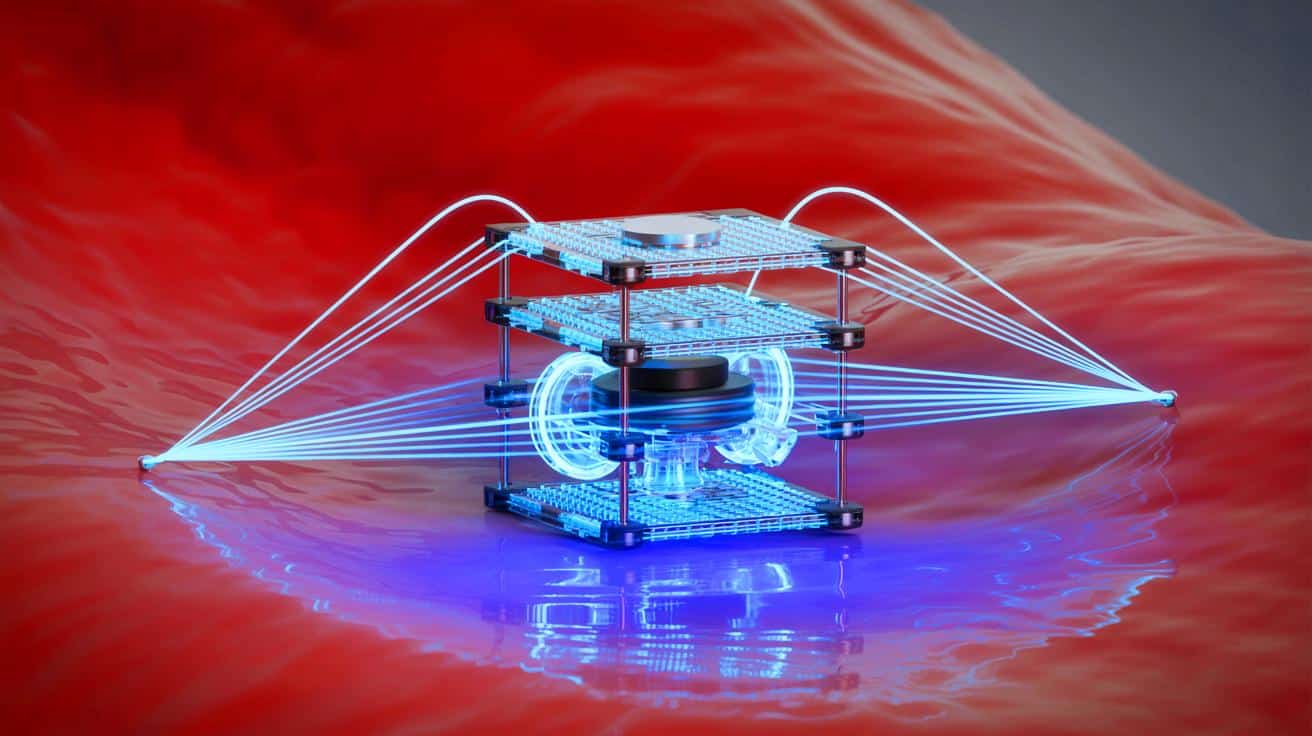
The innovation lies in the use of metasurfaces, thin sheets of silicon-based material with inscribed patterns that manipulate light. These surfaces are fabricated using the same technologies employed in manufacturing computer processors, making integration straightforward. Researchers have developed ring-shaped rotors, known as “metarotors,” which support these optical metasurfaces. When exposed to a laser beam, the metarotors diffuse light, creating torque that results in rotation.
This novel approach allows for the creation of gears just a few micrometers in size, comparable to a human cell. By adjusting the laser’s power, researchers can control the speed of the gear, while changing the light’s polarization can even reverse its direction. The ability to manipulate such small-scale devices with precision introduces a fundamentally new way of thinking about mechanics on a microscale.
Building Tiny Gear Trains
The researchers didn’t stop at creating individual gears. They successfully coupled multiple gears into trains, enabling the rotation of one to drive others. Depending on the gear sizes, torque or speed can be amplified, much like in larger machinery. In tests involving gear trains of three to five wheels, the system’s speed decreased more quickly than expected due to friction at contact points. However, the trains still performed as predicted by mathematical models.
Moreover, the team demonstrated a rack-and-pinion setup, where gear rotation was converted into linear motion.
This range of motion showcases that these machines are capable of performing work previously achievable only by large-scale mechanics.
Such innovations could have profound implications for the future of microengineering.
Permanent, Yet Small
The smallest gears created measure just eight micrometers across, similar in size to a red blood cell. Despite their delicate appearance, these machines are remarkably durable, operating continuously under light for up to 11 hours. They can also be stored for six months without losing functionality. Although their performance may decrease over time due to environmental changes, rejuvenating the surrounding fluid restores them to full speed.
This resilience suggests that these gears are not only efficient but also reliable. The ability to function effectively over extended periods makes them suitable for various applications, particularly in environments where traditional mechanics might fail.
A New Kind of Microengineering
The compatibility of this new approach with existing semiconductor technologies is particularly promising. Since the devices are etched using the same methods as computer chips, mass production is feasible. Unlike traditional systems, these light-powered machines require no wires or large magnets, making them ideal for integration into compact systems.
Light as an energy source offers significant advantages, including high selectivity and the ability to be directed and tuned with precision. At the wavelength used by researchers, the light is also harmless to many biological tissues, making it suitable for medical applications. This innovation represents a significant shift in how we view mechanical systems at a microscopic scale.
Medical and Technological Potential
The potential applications of these microscopic machines extend far beyond engineering. Given their size, they could revolutionize medical technology. Gan Wang, the lead researcher, envisions using micromotors as body pumps or valves to regulate fluid flow within the body. Their compatibility with optical systems further enhances their potential as tiny sensors or switches in lab-on-a-chip devices.
While current designs face challenges such as low efficiency and heating effects from high light intensity, the concept has already opened new avenues for research. Future developments could see these machines driving particles, moving fluids, or manipulating light in ways previously unimaginable. The prospect of having machines the size of cells become as ubiquitous in medical devices as gears are in cars is an exciting one.
Practical Implications of the Research
The implications of this technology are far-reaching, offering a new paradigm for powering and constructing microscopic systems. By eliminating the need for wires or magnets, engineers can design micro- and nanomachines that are easily integrated into chips or biological systems. This could lead to advancements in medical implants, lab-on-a-chip diagnostic devices, and optical switches for communication systems.
The potential for faster, safer, and more compact technologies in medicine, computing, and research is immense. As this technology continues to evolve, it raises important questions about how it will be applied and the ethical considerations that may arise. As we stand on the brink of this new frontier, what other innovations will emerge from the intersection of light and mechanics?