




| IN A NUTSHELL |
|
The Sun, a massive and dynamic star at the center of our solar system, continues to captivate scientists and the general public alike. Its behavior influences everything from the Northern Lights to the functioning of our power grids. Now, thanks to the extraordinary capabilities of the world’s most powerful solar telescope, located on a Hawaiian volcano, researchers are uncovering the Sun’s secrets with unprecedented clarity. This advanced technology is not just observing solar flares and sunspots; it is probing the fundamental forces that drive solar storms, which can have significant impacts on Earth’s infrastructure.
A New Eye on the Sun
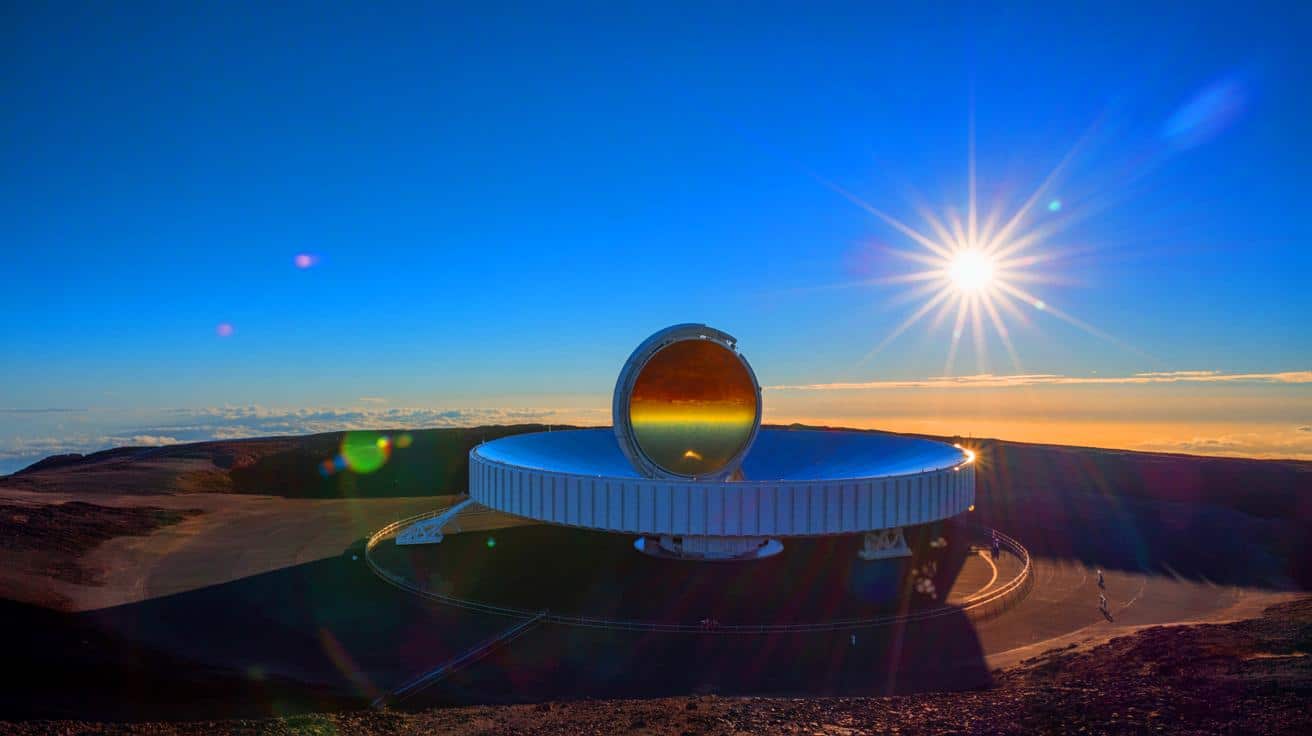
The Inouye Solar Telescope, perched atop Haleakalā in Hawaii, offers scientists the clearest ground-based view of the Sun. With its impressive four-meter-wide primary mirror, the telescope captures intricate details of the Sun’s surface and atmosphere. The location’s dry, stable air conditions are ideal for operating such a cutting-edge instrument. Since its inauguration in 2022, the telescope has provided remarkable close-ups of solar activity, revealing features as small as a few miles across.
Recently, the telescope has been equipped with advanced instruments to analyze sunlight more comprehensively. These tools deconstruct sunlight into its constituent properties, allowing scientists to gain deeper insights into solar dynamics. Four out of five planned instruments are now operational, with the Visible Tunable Filter (VTF) being the latest and most advanced addition. This marks a significant achievement, as the VTF has captured its first scientific data, heralding a new era in solar observation.
What Makes VTF So Special?
The Visible Tunable Filter is not just another instrument; it is a groundbreaking tool that provides unparalleled precision in solar observation. It functions by splitting the Sun’s light into extremely fine slices of wavelengths and analyzing the twists and turns of the light waves. This capability allows scientists to construct detailed maps of the Sun’s surface and lower atmosphere.
At the core of the VTF’s functionality are two sophisticated devices known as Fabry-Pérot interferometers. These devices filter light down to wavelengths of mere picometers, enabling the capture of highly detailed solar images. Each filtered slice of sunlight unveils various aspects of the solar surface, offering insights into temperature, pressure, plasma speed, and magnetic field strength at different layers.
“VTF enables images of unprecedented quality and thus heralds a new era in ground-based solar observation,” said Sami K. Solanki, a director at the Max Planck Institute for Solar System Research.
A Giant Heart for a Giant Telescope
The VTF is a technological marvel, weighing 5.6 tons and occupying space equivalent to a small garage. Developed over 15 years by engineers and scientists in Freiburg, Germany, its installation on the Inouye Solar Telescope began in early 2024. The VTF is metaphorically the “heart” of the solar telescope, now fully operational and transmitting high-resolution images at remarkable speeds.
Matthias Schubert, the VTF project scientist, noted the monumental nature of this achievement. “The commissioning of VTF represents a significant technological advance for the Inouye Solar Telescope,” he stated. The VTF now delivers hundreds of high-speed images per second, capturing features as small as six miles across. This data is invaluable for scientists worldwide, offering insights into solar dynamics and behavior.
Understanding the Sun’s Explosive Behavior
While the Sun might appear tranquil from our vantage point, it frequently erupts with powerful storms. These solar storms propel charged particles and radiation into space, potentially impacting Earth’s satellites, radio communications, and power grids. Understanding the origins of these eruptions is crucial for predicting their effects on Earth.
The key to predicting solar storms lies in the Sun’s photosphere and chromosphere, regions filled with hot plasma and complex magnetic fields. The VTF’s ability to focus on these regions with unprecedented clarity enables scientists to map out solar activity before it reaches Earth. By analyzing magnetic field strength, pressure, and temperature, researchers can better anticipate solar events and mitigate their impact on our technology-dependent world.
A Look at the First Light
The VTF’s inaugural image offers a breathtaking view of a sunspot, captured with extraordinary detail. Using sunlight at a wavelength of 588.9 nanometers, the image covers a section of the Sun’s surface about 15,500 miles wide, or roughly twice the size of Earth. This high-resolution image reveals the intricate structure of sunspots, including the dark central spot and the surrounding penumbra.
Sunspots occur where intense magnetic fields inhibit the rise of hot plasma, leading to a cooler, darker surface. With a spatial resolution of six miles per pixel, the VTF provides unprecedented insight into the texture and dynamics of these regions. Such images are instrumental in understanding the solar cycle, which spans approximately 11 years, and predicting future solar storms.
Looking Forward
Although the Inouye Solar Telescope has been operational for several years, the full capabilities of its instruments are only now being realized. The VTF’s integration marks a new chapter in solar science, offering more accurate readings of solar conditions and improved predictions of solar activity. This progress is vital for anyone relying on GPS, satellite data, or electricity, essentially everyone on Earth.
As scientists continue to analyze data from the Inouye Solar Telescope, they will deepen their understanding of the Sun’s complex behavior. This knowledge will be crucial in enhancing our ability to forecast and mitigate the effects of solar storms. How might this advanced understanding of solar phenomena transform our technological resilience in the face of solar disruptions?