




| IN A NUTSHELL |
|
In the realm of quantum science, breakthroughs often redefine what we thought possible. Recently, a team of researchers at the Blusson Quantum Matter Institute discovered a remarkable material, Ti₄MnBi₂, which exhibits one-dimensional magnetism while remaining metallic. This finding confirms long-theorized ideas about such systems and opens potential pathways to new technologies, including spin-based computing and quantum memory. The implications of this discovery are profound, as it not only challenges conventional understanding but also offers a tangible platform for future explorations in quantum physics.
A Rare Blend of Metal and Magnetism
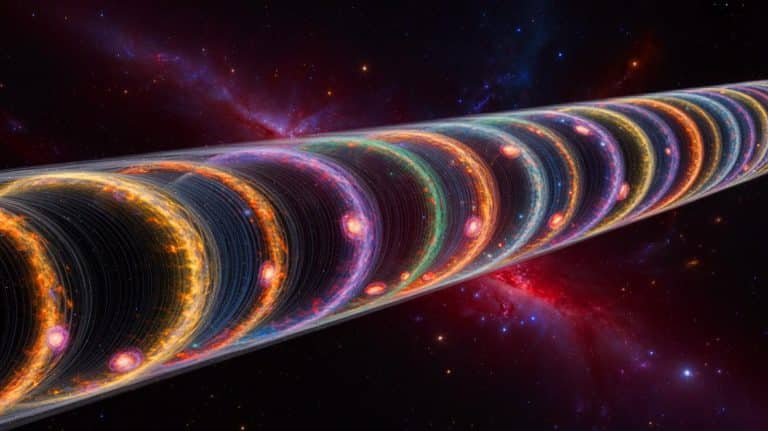
Ti₄MnBi₂ is a groundbreaking compound that showcases unique properties. Its magnetic behavior is confined to a single direction, forming what scientists call a spin chain. In this structure, each “bead” or magnet interacts linearly along the chain. What makes Ti₄MnBi₂ exceptional is its ability to maintain this one-dimensional magnetic behavior while allowing electrical conductivity. This is a rare trait among spin chains, which are typically insulating.
Unlike many materials, Ti₄MnBi₂ retains its one-dimensional magnetism even at temperatures nearing absolute zero. This is crucial because, at such low temperatures, quantum effects dominate, often altering material properties. The persistence of one-dimensional magnetism, despite minimal interaction between chains, means scientists now have a real-world material to validate theories that previously existed only in mathematical models. As Professor Meigan Aronson, a lead investigator, noted, this material establishes a new class of quantum materials that are both metallic and one-dimensional magnets, with significant coupling between magnetic moments and their metallic host.
Uncovering the Quantum Puzzle
The discovery of Ti₄MnBi₂ wasn’t just about observing its properties visually. Researchers employed neutron scattering, a sophisticated technique to analyze atomic arrangements and behaviors. This method provided definitive proof of the material’s one-dimensional spin behavior. Complementary computer modeling using the Density Matrix Renormalization Group (DMRG) further corroborated these findings.
Interestingly, Ti₄MnBi₂ is situated near a “quantum critical point,” a state where it balances delicately between different quantum phases. Such phases are akin to water existing as ice or vapor, but in quantum materials, these changes are driven by quantum rules rather than temperature. The pronounced quantum fluctuations prevent spins from forming a regular pattern, a phenomenon distinct from three-dimensional materials, where low temperatures lead to fixed spin structures. This unique positioning of Ti₄MnBi₂ offers insights into the fundamental nature of quantum systems.
Building a Path Toward Quantum Technology
The implications of Ti₄MnBi₂’s discovery extend far beyond academic interest. Its ability to maintain one-dimensional and metallic characteristics simultaneously paves the way for innovative quantum technologies. These could include advanced memory storage solutions leveraging spins instead of electric charges, as well as more efficient quantum simulators for modeling complex quantum systems.
As Dr. Alberto Nocera highlighted, the material serves as an ideal testbed for quantum analog simulations, offering fresh insights into potential magnetic memories with high density and speed. The exceptional congruence between experimental and theoretical results also provides a benchmark for future quantum simulations. By comparing Ti₄MnBi₂’s real-world behavior with theoretical predictions, scientists can refine their understanding of quantum entanglement, a fundamental aspect of quantum mechanics where particles remain interconnected regardless of distance.
A Team Effort From Lab to Theory
The success of this discovery was driven by a collaborative effort at the Blusson Quantum Matter Institute. On the experimental front, Dr. Xiyang Li and Dr. Mohamed Oudah meticulously prepared the crystals, producing over 100 batches and aligning more than 400 crystals for high-quality neutron scattering tests. These critical experiments were conducted at J-PARC in Japan, a leading research facility.
Meanwhile, the theoretical work was spearheaded by Dr. Nocera and Dr. Kateryna Foyevtsova, alongside Professors George Sawatzky and Meigan Aronson. Through advanced simulations and modeling, they were able to predict and validate the neutron scattering results. Dr. Li, the paper’s first author, emphasized that their findings unlock new opportunities to explore material systems with potential applications in emerging quantum technologies.
As the quest for reliable quantum materials continues, Ti₄MnBi₂ stands out with its rare combination of properties. This material bridges the gap between metals that conduct electricity and magnets that store information, potentially becoming the cornerstone of next-generation quantum circuits. Could this discovery be the key to unlocking the full potential of quantum computing in the near future?