



| IN A NUTSHELL |
|
Primordial black holes (PBHs) represent one of the universe’s most intriguing enigmas. These tiny yet massive objects, potentially formed a fraction of a second after the Big Bang, could hold the key to some of cosmology’s most persistent mysteries. Unlike black holes that result from dying stars, PBHs could be as small as an atom yet contain mass equivalent to a mountain. Scientists have long speculated that these ancient relics might explain the elusive nature of dark matter and account for unusual gravitational phenomena. Despite their theoretical significance, no primordial black hole has ever been directly observed. However, a new study suggests that evidence of their existence might be found much closer to home, in the rocks beneath our feet.
A New Way to Spot the Invisible
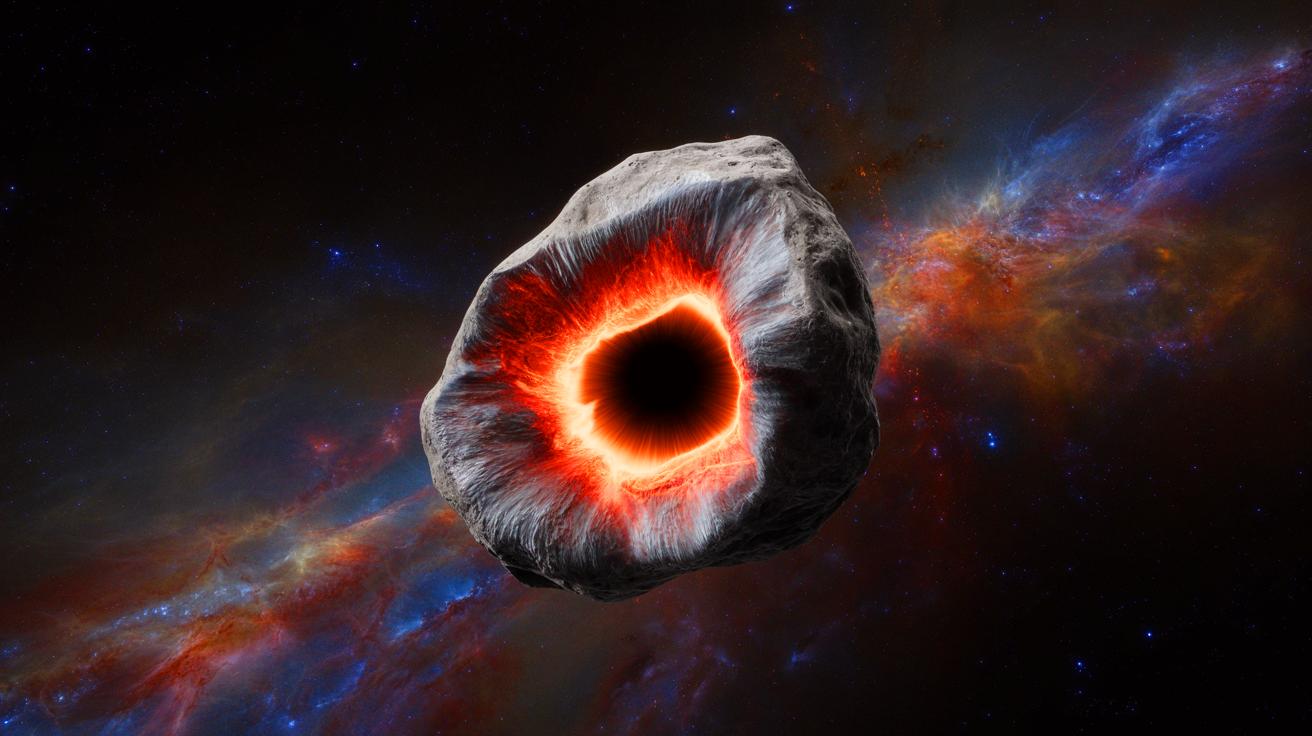
In a groundbreaking study published in the journal Physics of the Dark Universe, physicists Dejan Stojkovic and De-Chang Dai propose a novel approach to detecting PBHs. They suggest that these black holes may have left detectable traces as they interacted with planets, asteroids, and other cosmic bodies. If a PBH became trapped inside a planet with a liquid core, it could gradually consume the core, leaving the outer shell intact. The result would be a hollow celestial body, stable for billions of years if the shell were strong enough.
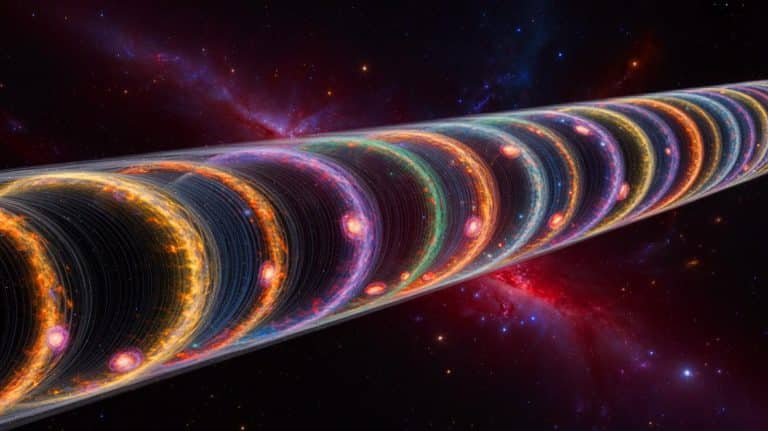
Stojkovic points out that such hollow objects could be identified by studying their densities. “We can detect these hollow objects by studying their orbits,” he explains. If a body’s density is too low for its size, it might indicate a hollow structure. In solid asteroids, PBHs could create narrow tunnels, perfectly straight and mere microns wide, leaving a mark that could persist for eons.
Hollow Asteroids in the Solar System
The possibility of hollow planets and asteroids may sound improbable, but Stojkovic and Dai’s research shows that common planetary materials could indeed support such structures. They analyzed the strength of minerals like granite, quartz, and iron to determine if they could resist collapse without a core. Surprisingly, many materials are strong enough to maintain a hollow form, especially if the PBH is small.
This raises questions about certain asteroids in our solar system. For instance, Lutetia and Vesta, both of which likely had molten interiors, may have been hollowed out by PBHs. Smaller objects like Bennu and Ryugu also show unusual lightness for their size. While current models describe them as “rubble piles” of loosely bound rock, the possibility of PBH interactions remains open. Given that spacecraft have visited these asteroids, scientists have the necessary tools to test these ideas further.
Tunnels on Earth
Closer to home, PBHs might leave traces on Earth itself. Stojkovic describes a scenario where a PBH passes through the Earth, moving too quickly and with too little energy to be noticed. The result would be a micrometer-wide tunnel, a clean hole akin to a bullet passing through a window. Unlike meteorite impacts, which create surface craters, PBH tunnels would penetrate straight through.
The chances of witnessing such an event are slim, but the search is cost-effective. Existing geological samples and slabs of metal could serve as PBH detectors. If scientists identify microscopic tunnels within these materials, it could provide indirect evidence of PBHs and, consequently, dark matter. This approach offers a novel and affordable way to pursue one of astronomy’s most elusive targets.
How Long Does It Take?
The timeframe for a PBH to hollow out a celestial body depends on its size and the object’s density. In stars, this process could take millions of years. However, in smaller worlds, particularly those with liquid cores, the timeline could be much shorter. A low-mass PBH might consume a kilometer-wide liquid core in mere months or years, suggesting that hollow worlds could already exist within our solar system.
Beyond detection, the study also explores potential applications for PBHs. Hypothetically, surrounding a PBH with a large shell might allow for energy capture from Hawking radiation or an accretion disk. However, engineering such a structure remains beyond current human capabilities. Materials would need to withstand intense forces, a challenge no known substance can meet near a solar-mass black hole.
Why It Matters
Detecting primordial black holes would revolutionize our understanding of physics and cosmology. These entities could validate dark matter theories, reshape our view of the universe’s early days, and open new pathways in scientific exploration. Stojkovic emphasizes the need for innovative thinking in this field, acknowledging that traditional approaches have yet to yield results. “The smartest people on the planet have been working on these problems for 80 years and haven’t solved them,” he notes. “We probably need a completely new framework altogether.”
While the likelihood of success is uncertain, the potential impact is profound. Discovering evidence of PBHs would not only solve a cosmic mystery but also alter our perception of the universe. Could hollow asteroids or microscopic tunnels serve as the first evidence of these primordial entities? Such findings would not only confirm a new type of black hole but also bolster the hypothesis that dark matter consists of them. This prospect raises the question: What other secrets might the universe hold that we have yet to uncover?