




| IN A NUTSHELL |
|
Warp drive, a concept once confined to the realms of science fiction, is now being seriously considered by scientists as a potential means to travel faster than light. Originating from popular media like Star Trek and Star Wars, the idea of bending spacetime to reach distant stars has captured the imagination of both the public and the scientific community. Recent studies have begun exploring the theoretical foundations and practical challenges of realizing such technology, raising questions about its feasibility and the implications of surpassing the cosmic speed limit set by Einstein’s Theory of Relativity.
Understanding Warp Drives: How It Works
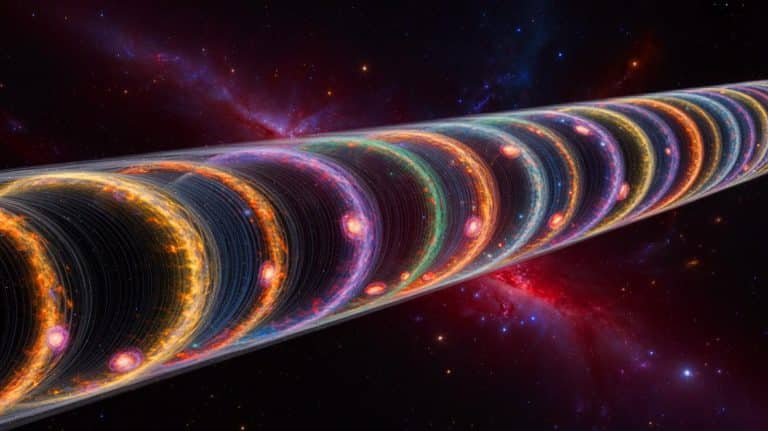
The concept of warp drives does not rely on traditional propulsion methods. Instead, it involves bending spacetime itself. This theory was first introduced by physicist Miguel Alcubierre in 1994. Alcubierre’s idea was to create a “warp bubble” around a spacecraft that compresses space in front while expanding it behind. This would allow the craft to remain stationary within the bubble, effectively moving faster than light as spacetime itself shifts. This concept cleverly navigates Einstein’s universal speed limit by not accelerating the craft itself, but rather the space around it.
Joseph Agnew, a student at the University of Alabama, explained this theory succinctly: “Suppose you have a craft that’s in the bubble. You’d compress spacetime ahead of the craft and expand spacetime behind it.” The passengers would not experience motion in the traditional sense; instead, their destination would simply appear to approach faster than normal.
The Physics Behind the Fantasy
Einstein’s Theory of Relativity asserts that nothing with mass can travel at or faster than the speed of light due to the infinite energy required. However, the warp bubble concept sidesteps this rule, as the bubble, rather than the spacecraft itself, can theoretically exceed light speed. The primary challenge lies in the requirement for “negative energy” or “negative mass,” which are exotic materials predicted by quantum physics but not yet produced in practical quantities.
Alcubierre’s initial proposal suggested that generating a warp bubble would require negative energy equivalent to the mass of Jupiter. This is far beyond our current technological capacity. Nevertheless, NASA physicist Dr. Harold “Sonny” White has been working on refining the bubble’s shape, suggesting that these energy requirements could be reduced to about 1,500 pounds, making the concept slightly more attainable.
Challenges and Controversies
Despite the theoretical appeal, the practical realization of warp drives faces significant hurdles. Negative energy, while supported by quantum mechanics, remains elusive in substantial quantities. Experiments like the Casimir effect have demonstrated small amounts of negative energy, but not enough to power a warp drive. Additionally, theoretical models have revealed potential pitfalls, such as quantum fields at the warp bubble’s edges becoming infinitely large and unstable.
Even with a possible reduction in energy requirements, the creation of a viable warp bubble would still demand immense amounts of negative energy. Some researchers propose reshaping the bubble to further decrease this demand, but even these adjustments would still require energy comparable to that of a star. Furthermore, physicist Tim Dietrich from Potsdam University warns of causality paradoxes that could arise with faster-than-light travel, which might disrupt our understanding of cause and effect.
Could Warp Drive Be Possible Soon?
Despite the challenges, scientists remain cautiously optimistic. Professor Geraint Lewis of the University of Sydney suggests that the discovery of exotic matter within the next century could bring warp drives closer to reality. He notes that while Einstein’s theories are over a century old, the surface has only been scratched in terms of their potential applications. Dr. White at NASA envisions initial journeys combining warp drives with traditional propulsion systems, potentially reducing travel time to nearby stars from centuries to months.
These optimistic projections, however, are tempered by the massive scientific and technological advancements required. The possibility of seeing warp drives become a reality within the next few centuries relies not only on breakthroughs in physics but also on engineering and energy management. As research continues, the scientific community remains committed to exploring the boundaries of what is possible.
Detecting Warp Drives: Hunting Alien Technology
Even if humanity has yet to develop warp drives, the search for evidence of such technology in the universe is underway. Dr. Katy Clough, a cosmologist at Queen Mary University of London, suggests that collapsing warp bubbles could emit detectable gravitational waves. If such waves exist, they could be identified using Earth-based detectors, offering proof that another civilization has already mastered warp travel.
Dr. Clough humorously noted the potential need for significant funding to develop such detection technology. However, the pursuit of these signals could provide insights into the existence of advanced extraterrestrial technology and the potential for interstellar communication.
The path to realizing warp drive technology is fraught with challenges, both theoretical and practical. Yet, the pursuit itself pushes the boundaries of human understanding and technology. As scientific exploration continues, we must ask: how far are we willing to go to turn science fiction into science fact, and what will we discover along the way?