




| IN A NUTSHELL |
|
In a significant leap forward for technology, researchers have made a breakthrough in quantum computing that could transform the way we solve complex real-world problems. At the core of this advancement is a new type of chip, designed to manage the delicate qubits essential for quantum processing. For years, scientists have grappled with the issue of controlling these fragile quantum bits without disrupting the information they carry. Now, with the development of a cryogenic control system operating just above absolute zero, this challenge is being met, bringing practical, scalable quantum computing within reach.
Understanding the Role of Spin Qubits
Spin qubits are at the heart of cutting-edge research in quantum computing. These qubits use the magnetic orientation of a single electron to store data. What makes spin qubits particularly promising is their compatibility with existing CMOS technology, the very same technology used in modern smartphones and laptops. This compatibility suggests that current manufacturing processes, already adept at producing billions of transistors, could also be applied to create millions of qubits. This potential scalability could make spin qubits more cost-effective and easier to produce than other types of quantum systems.
The compact size of spin qubits adds to their appeal. Each qubit occupies a space smaller than a micron, enabling engineers to pack millions onto a single chip. However, a significant challenge remains: each qubit requires multiple control lines to function. Managing millions of these connections with existing room-temperature setups is unfeasible. To address this, researchers have explored positioning control electronics in close proximity to the qubits at cryogenic temperatures. This approach, however, presents a new obstacle: the potential for heat or noise to disrupt fragile quantum states.
Innovations in Cryogenic Control
Taking on the challenge, researchers from the University of Sydney, in collaboration with the University of New South Wales and several quantum start-ups, have developed a silicon chip that manages spin qubits at milli-kelvin temperatures. This is just above absolute zero, a state where atomic movement is nearly nonexistent. Such a feat required over a decade of dedicated effort in designing electronics that consume minimal power while functioning at these extreme conditions.
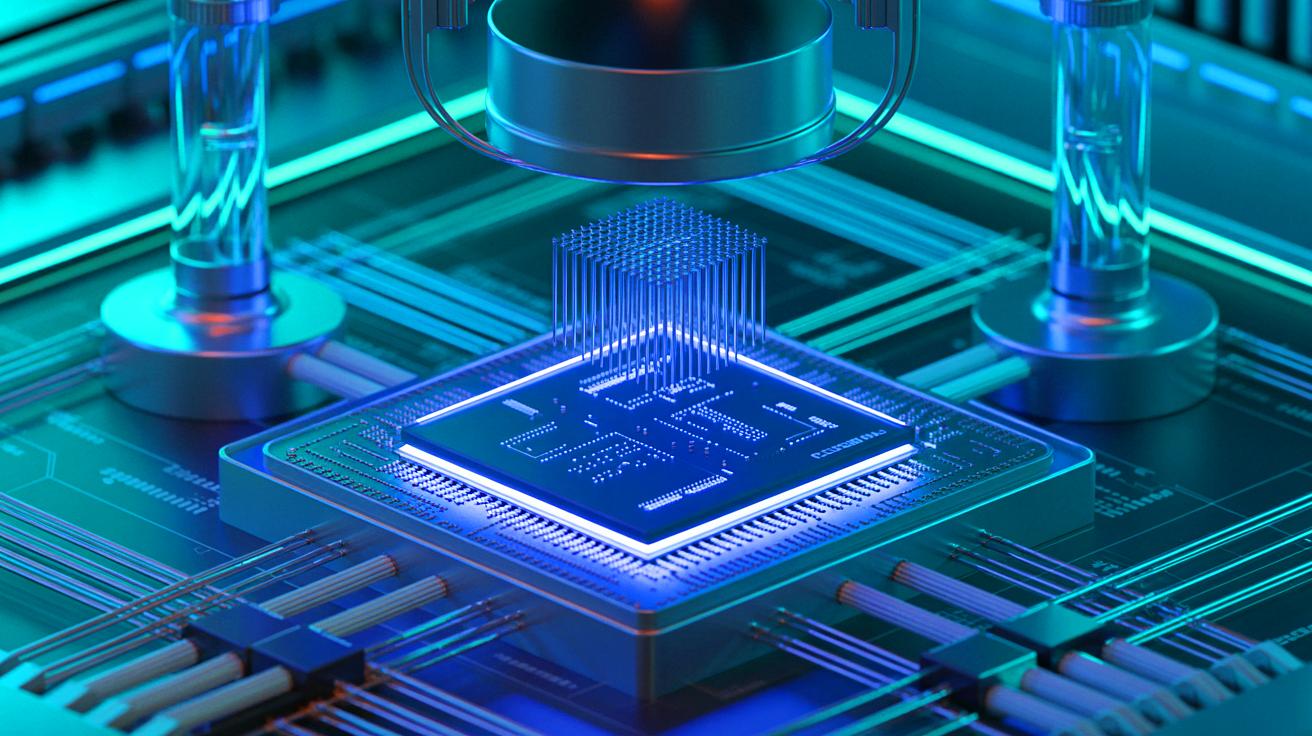
Their cryogenic CMOS control system, which contains around 100,000 transistors, operates in close proximity to the qubits without interfering with them. This achievement marks a significant breakthrough, as it allows both control and computing components to share the same space. This integration mirrors the design of classical computers and could revolutionize quantum computing by enabling a “chiplet-style” approach. This compact module design is key to scaling quantum computers from the current count of fewer than 100 qubits to potentially millions in the future.
Testing the Limits of Quantum Control
To validate their design, the research team conducted extensive tests on the new chip, comparing its performance to standard room-temperature setups. They assessed single-qubit and two-qubit operations for any signal loss, heat interference, or increased noise. According to Dr. Sam Bartee, the study’s lead author, the results showed negligible fidelity loss for single-qubit operations and no measurable reduction in coherence time for both one- and two-qubit operations. This indicates that the control chip does not disturb the qubits, despite being less than a millimeter away.
The tests revealed consistent qubit behavior, suggesting minimal electrical noise from the control chip. Impressively, the entire system operates using just 10 microwatts of power, with the analog components requiring only about 20 nanowatts per megahertz. This low power consumption is crucial for scaling the system to millions of qubits without introducing thermal issues. Dr. Kushal Das, who designed the control chip, highlighted the complexity involved, noting that building low-noise, ultra-efficient cryogenic electronics is a skill that takes years to master.
Bridging Science and Industry
This project exemplifies the synergy between scientific research and industrial application. The control chip was developed at the University of Sydney, while the qubits were provided by Diraq, a spin-off from the University of New South Wales. Professor David Reilly’s start-up, Emergence Quantum, aims to commercialize the technology, positioning Sydney as a key player in the global quantum industry.
Beyond quantum computing, cryogenic control systems have potential applications in sensitive measurement tools, medical devices, and energy-efficient data centers. For now, the focus remains on advancing the future of computing. Diraq CEO Professor Andrew Dzurak emphasized the importance of this development, stating that integrating silicon qubits with classical control electronics into a single unit makes quantum computers more affordable and efficient.
The Road Ahead for Quantum Machines
Creating quantum computers capable of solving practical problems involves managing errors and handling thousands or even millions of qubits without losing quantum information. This requires control systems that function effectively on a large scale and under extreme conditions. The new research addresses a critical part of this challenge, demonstrating that cryo-CMOS electronics can coexist with qubits without impairing their performance. Moreover, the low power requirements prevent the system from overheating, and the use of standard technology paves the way for mass production.
Dr. Bartee, now working at Diraq, expressed enthusiasm about the progress, noting that the tools being developed have the potential to unlock immense computational power. This breakthrough brings the vision of practical quantum machines closer to reality, offering the possibility of tackling complex challenges such as drug discovery and climate modeling.
As quantum computing continues to evolve, researchers and industries must navigate the complexities of scaling and integration. How will these advancements shape the future landscape of technology and industry?