

| IN A NUTSHELL |
|
For centuries, the scientific community has understood matter as existing in four primary states: solid, liquid, gas, and plasma. This knowledge has formed the backbone of physics education and research. However, recent groundbreaking work by a team of researchers led by Rutgers University has introduced a fifth state of matter, known as a quantum liquid crystal. This new phase was discovered at the interface of two exotic materials, challenging established scientific concepts and opening the door to innovative technologies.
The Quantum Sandwich: A New Structure Emerges
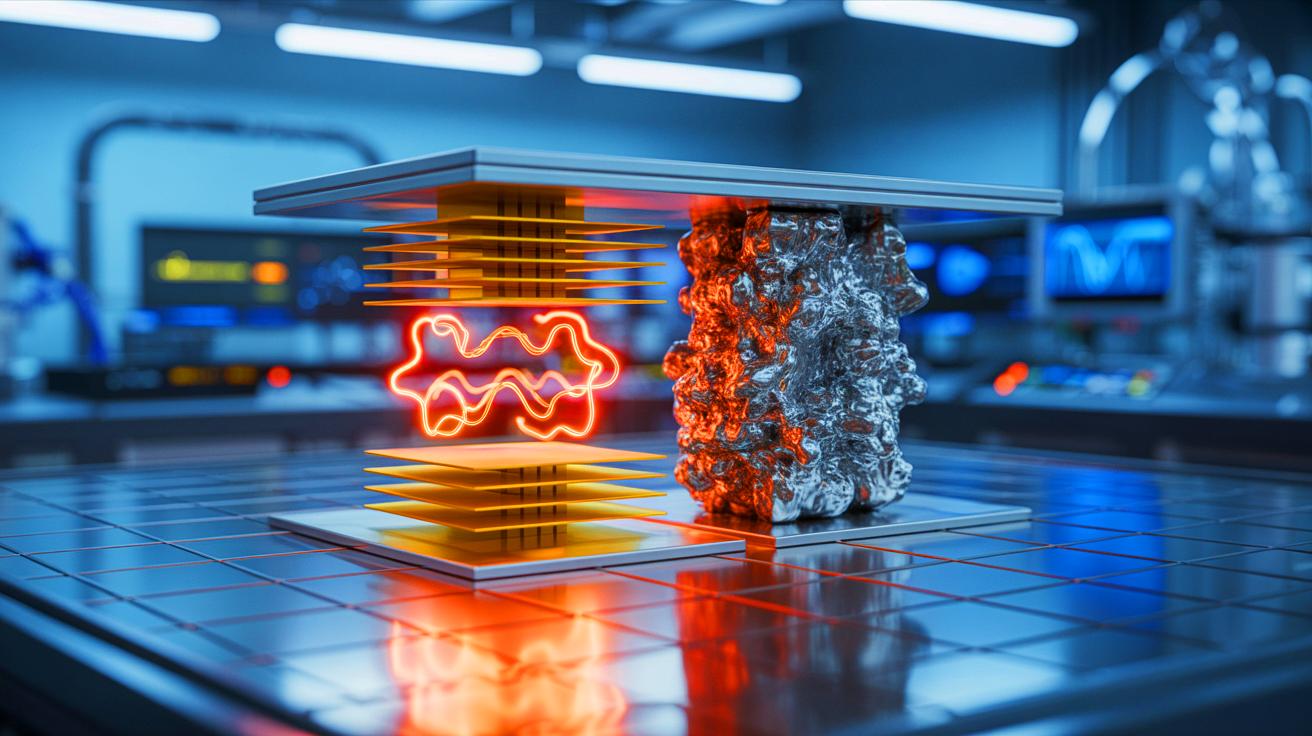
To uncover this new state of matter, researchers had to innovate beyond traditional methods. They constructed a heterostructure, a layered assembly of two distinct materials, resembling an atomically precise sandwich. Each layer was chosen for its unique properties, creating a complex interaction zone at their boundary. This endeavor required the development of the Q-DiP, or quantum phenomena discovery platform, a custom machine capable of assembling these structures atom by atom.
The first layer of this quantum sandwich is a Weyl semimetal, notable for its exceptional conductivity due to the presence of Weyl fermions. These particles facilitate a nearly lossless flow of electricity, akin to electrons traveling along a superhighway. The second layer comprises a spin ice, an insulating magnet with a complex internal magnetic structure. Its arrangement mirrors the pattern of hydrogen atoms in frozen water ice, presenting a frustrated magnetic configuration rather than the straightforward alignment found in ordinary magnets.
Individually, both materials have been studied extensively, yet their combination at the interface had never been explored until now. This novel assembly allowed researchers to investigate the uncharted quantum territory, revealing new physics at the boundary where these two materials meet.
An Unexplored Frontier: Discovering New Phases
By combining two distinct quantum materials, researchers ventured into an unexplored frontier, where the interface between them offers the potential for entirely new states of matter. The Rutgers team selected materials from the magnetic pyrochlore family, which are known for their rich quantum effects due to their unique crystal structures. The choice of a pyrochlore iridate as the Weyl semimetal and a pyrochlore titanate as the spin ice was instrumental in their success.
The team conducted their experiments at the National High Magnetic Field Laboratory in Florida, employing extreme conditions to unlock the secrets of their heterostructure. The combination of ultra-low temperatures and powerful magnetic fields was crucial in revealing the material’s properties. It was under these conditions that the quantum liquid crystal emerged, showcasing behaviors unseen in single-material systems.
Understanding the interaction between the two layers provided insights into new quantum phases. These discoveries highlight the potential of engineered interfaces in creating novel materials with specific electronic and magnetic properties.
Strange New Rules of Flow: Observing Anisotropy
Within the powerful magnetic fields of the MagLab, the quantum sandwich exhibited unexpected behavior. The interaction between the spin ice and the Weyl semimetal resulted in electronic anisotropy, where the material’s conductivity varied with the direction of the current. This phenomenon is rare and indicative of new physics at play.
As researchers rotated the material within the magnetic field, they observed a distinct sixfold pattern of electrical resistance. This pattern was influenced by the magnetic properties of the spin ice, altering the flow of electrons within the semimetal. Further increasing the magnetic field led to a dramatic shift, with electrons flowing in just two opposite directions, a hallmark of rotational symmetry breaking and the birth of a new organized state of matter.
The discovery of these behaviors provides a deeper understanding of quantum materials and the potential to harness these properties in future technologies.
Cracking the Quantum Code: Collaborative Success
The complexity of the experimental results required a collaborative approach between experimentalists and theorists. Led by Professor Jak Chakhalian, the team worked closely with the theoretical group led by Associate Professor Jedediah Pixley. This partnership was essential in interpreting the data and providing a theoretical framework for the observed phenomena.
Theoretical modeling and simulations played a critical role in understanding the quantum interactions at the interface. These efforts confirmed the emergence of a new many-body state, offering novel ways to manipulate material properties. The research holds promise for the development of advanced quantum sensors and other technologies that leverage these unique quantum behaviors.
This collaboration highlights the importance of interdisciplinary efforts in pushing the boundaries of scientific knowledge and exploring the vast potential of quantum materials.
The discovery of a quantum liquid crystal as a new state of matter marks a significant milestone in materials science. By exploring the interactions at the interface of complex materials, researchers have opened new avenues for innovation. This breakthrough raises intriguing questions about the future applications of such materials. How might these discoveries influence the development of next-generation technologies and further our understanding of the quantum world?

Wow, a 5th state of matter? Just when you think you know everything! 🤯
Can this quantum liquid crystal be used in everyday electronics?
Thank you for such an intriguing article! It’s amazing to see science evolve. 🌟
Quantum liquid crystal sounds like something out of a sci-fi movie!
How does this discovery compare to the previous four states of matter?