



| IN A NUTSHELL |
|
In the vast expanse of the Milky Way galaxy, most stars adhere to predictable paths, orbiting the galactic center at steady speeds. However, astronomers have identified a rare subset of stars, known as hypervelocity white dwarfs (HVWDs), which defy this norm. These stellar phenomena, the remnants of stars that have exhausted their nuclear fuel, travel at astonishing speeds, capable of escaping the galaxy’s gravitational pull. Recent research led by Dr. Hila Glanz of the Technion: Israel Institute of Technology has provided groundbreaking insights into the forces behind these celestial speedsters, challenging long-held assumptions in the field of astrophysics.
Rethinking Old Explanations
For decades, the mystery of hypervelocity white dwarfs puzzled astronomers, who relied on a model known as the “D6 scenario.” This model suggested that two white dwarfs spiraled together, with the heavier star siphoning helium from its companion, eventually leading to a type Ia supernova. The explosion would then propel the lighter star at high velocities. However, the model didn’t align well with observational data. It required an unusually massive white dwarf to function and failed to explain why some runaway stars appeared unusually hot and large.
Dr. Glanz’s team proposed a novel approach, suggesting that a pair of hybrid helium, carbon, oxygen white dwarfs, or HeCO dwarfs, might be responsible. Unlike pure carbon-oxygen dwarfs assumed in older models, these stars contain layers of helium and carbon-oxygen, giving them unique structural properties. When they collide, the resulting explosion creates the brightness and speeds observed in hypervelocity white dwarfs. This new perspective not only better fits the data but also opens new avenues for understanding stellar dynamics.
A Cosmic Collision in Action
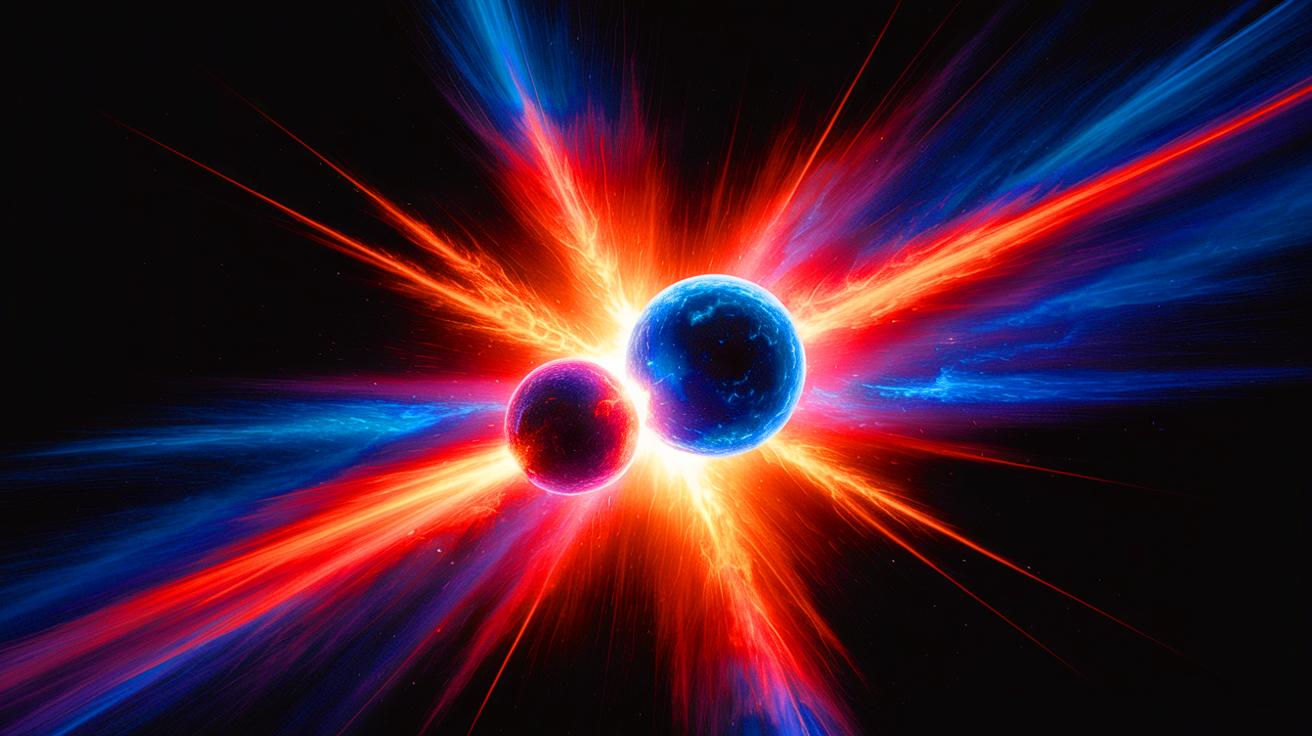
To test their hypothesis, the researchers employed the Arepo simulation code, which models extreme astrophysical events. They simulated a binary system with two HeCO white dwarfs, one with 0.68 solar masses and the other with 0.62. As the smaller star was pulled by its partner’s gravity, it began transferring material to the larger star. This accumulation of helium eventually led to a detonation across the larger star’s surface, igniting its carbon-oxygen core and causing a secondary, more violent explosion.
The primary star was obliterated in this thermonuclear event, while the companion was partially torn apart but survived. The remaining core was ejected at more than 2,000 kilometers per second, explaining the high speeds of HVWDs. The simulation also demonstrated that such runaway dwarfs shine brighter and larger than typical white dwarfs due to the heat and expansion from the explosion, matching observations of stars like J0546 and J1332.
Unusual Supernova Fireworks
The supernova resulting from this merger was not a typical type Ia explosion. It released 1.13 × 1051 ergs of energy and produced about 0.072 solar masses of radioactive nickel-56. This isotope usually powers the bright glow of supernovae, but in this case, the smaller amount of nickel resulted in a faint and peculiar blast. Such explosions may account for rare underluminous supernovae, often termed “91bg-like” events, observed in older galaxies.
With the debris from the simulated explosion traveling at high velocities, future astronomical observations might detect both a hypervelocity white dwarf and the remnants of its partner’s explosion, further validating the model. To understand the long-term fate of these stellar remnants, researchers used the MESA stellar evolution code. Initially, the star spins rapidly and appears inflated due to the blast. Over millions of years, it cools, shrinks, and slows, but remains hotter and larger than a typical white dwarf of the same mass.
A Broader View of Stellar Explosions
This research extends beyond explaining a few runaway stars. Type Ia supernovae are crucial for measuring the universe’s expansion, yet their origins are not fully understood. If some originate from HeCO mergers, as suggested by this study, astronomers may need to refine how they interpret supernova data. Prof. Hagai Perets, a co-author of the study, noted, “This discovery doesn’t just help us understand hypervelocity stars, it gives us a window into new kinds of stellar explosions.”
Given that hybrid white dwarfs might constitute a significant portion of white dwarf pairs, this pathway could be more common than previously thought. Even if only a small fraction end in hypervelocity remnants, they could account for the few discovered so far. As astronomical surveys continue, more hypervelocity dwarfs are likely to be found, providing further evidence of their origins and offering new insights into the violent processes that shape stars and galaxies.
Practical Implications of the Research
The study of hypervelocity white dwarfs has implications far beyond the curiosity of fast-moving stars. These objects serve as test cases for supernova theories, which are pivotal in measuring cosmic distances and understanding the universe’s expansion rate. The findings also illuminate rare underluminous supernovae, helping astronomers comprehend how elements are created and distributed across galaxies. By tracing the origins of runaway white dwarfs, scientists not only solve a long-standing puzzle but also gain a deeper understanding of stellar lifecycles and the forces molding the cosmos.
The discovery of hypervelocity white dwarfs and the mechanisms behind their incredible speeds have reshaped our understanding of stellar dynamics. As this new model gains traction, it invites further inquiries into the nature of these cosmic phenomena. How might future technological advancements in observation and simulation further refine our understanding of these high-speed stars and their role in the broader context of the universe?