



| IN A NUTSHELL |
|
In a landmark scientific achievement, researchers have confirmed one of Stephen Hawking’s most famous predictions about black holes. This breakthrough comes a decade after gravitational waves were first detected, marking a new era of cosmic observation. The study validates Hawking’s “area law,” which posits that the total surface area of a black hole’s event horizon can never decrease. This discovery not only reaffirms Hawking’s theory but also strengthens Einstein’s general relativity, offering fresh insights into the universe’s most mysterious phenomena.
Hawking’s Vision Put to the Test
In the 1970s, Stephen Hawking introduced the idea that a black hole’s surface area could only increase over time, paralleling the second law of thermodynamics. This law states that entropy, or disorder, must grow in a closed system. If proven false, it would challenge the fundamentals of Einstein’s general relativity and our understanding of the universe. For decades, physicists questioned whether this principle would withstand the violent conditions of black hole mergers.
The recent analysis, based on the strongest gravitational wave signal, GW250114, confirms that Hawking’s rule holds true. This signal, recorded with unprecedented clarity, offers definitive evidence that the final black hole’s horizon area exceeds the combined areas of the initial black holes involved in the collision. With this confirmation, Hawking’s vision remains a cornerstone of modern astrophysics.
The Loudest Gravitational Wave Yet
Gravitational waves are typically faint, but the GW250114 event, detected by the Laser Interferometer Gravitational-Wave Observatory (LIGO) and its international partners, was different. With a signal-to-noise ratio of 80, it was the clearest signal recorded to date. As Geraint Pratten of the University of Birmingham stated, the event was akin to “a whisper becoming a shout,” providing a unique opportunity to rigorously test Einstein’s theories.
This clarity allowed researchers to analyze the signal in two stages: the inspiral, where the black holes orbited each other, and the ringdown, where the final black hole vibrated like a bell. Each phase provided enough data to calculate the horizon areas before and after the merger, confirming the area law with significant confidence.
Measuring the Change in Horizon Area
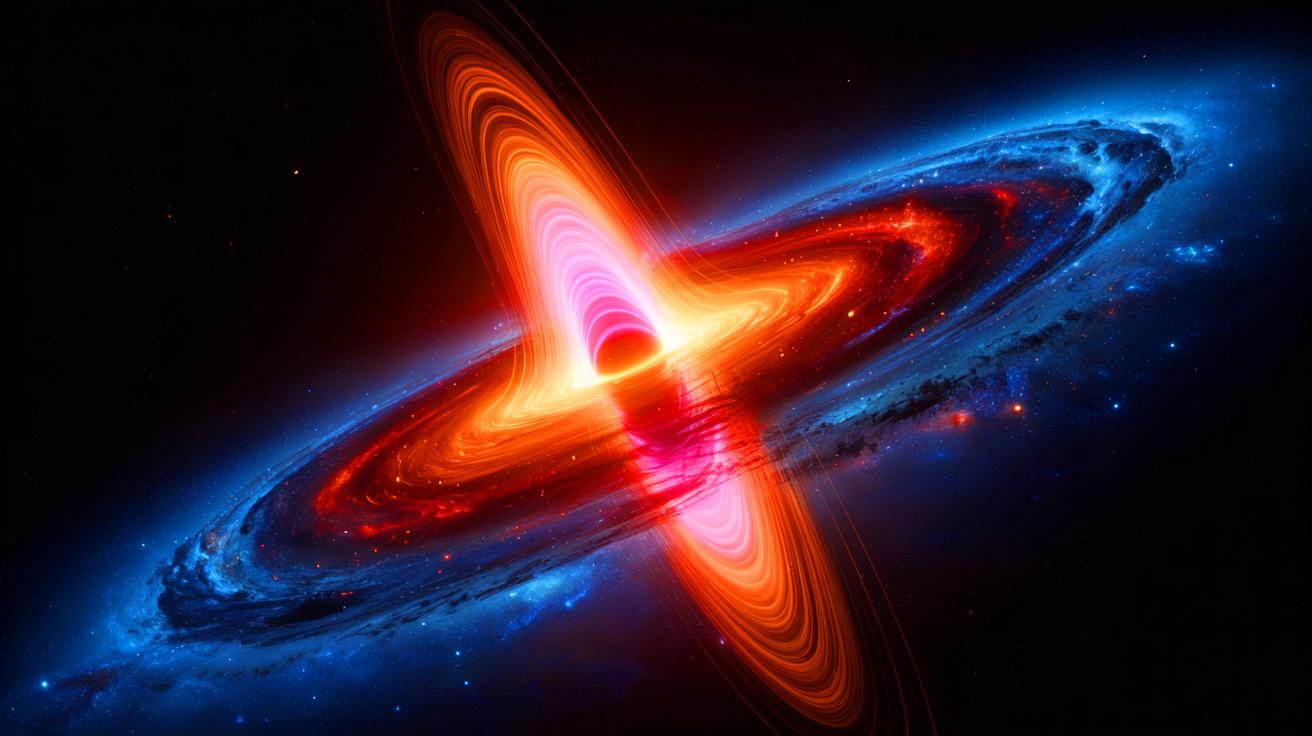
Before merging, the black holes had masses approximately 32 times that of the Sun, with a combined surface area similar to that of the United Kingdom. Post-collision, the new black hole’s area expanded to nearly the size of Sweden. This substantial increase was not a mere statistical anomaly. In physics, a 5σ result is considered the gold standard for discovery, and the increase in area achieved that level of confidence.
The results, derived from different data slices, consistently supported the area law, affirming that the outcome was not a product of chance. This finding provides a robust confirmation of Hawking’s prediction, demonstrating the immense forces at play during such cosmic events.
Listening to Black Hole “Voices”
Black holes emit specific vibrations known as quasinormal modes, much like a bell ringing. For GW250114, the dominant frequency was measured at 247 hertz, decreasing at about 221 hertz per second. Gregorio Carullo from the University of Birmingham emphasized the significance of this clarity, allowing researchers to identify two distinct “tones” from the black hole’s “voice.” This confirmed that the black holes adhered to the Kerr metric, a mathematical model predicting how spacetime is distorted around a spinning black hole.
The Kerr metric, developed in 1963, describes phenomena such as light circling a black hole and the dragging of space itself. Confirming these behaviors with the GW250114 event strengthens the evidence that black holes observed by LIGO align with theoretical predictions made decades ago.
Independent From Assumptions
The strength of this study lies in its independence from model-based assumptions. By treating pre-merger and post-merger signals separately, researchers avoided bias toward the area law. The result, that the final horizon area surpassed the initial areas, emerged directly from the data.
This independent approach sets GW250114 apart from earlier events like the 2015 detection, which reached only 2σ confidence and relied on assumptions about wave polarization. In contrast, the new event exceeded 5σ, excluding the messiest data parts, giving researchers confidence in their observations.
A Boost for Einstein’s Legacy
Confirmation of the area law is a significant triumph for Einstein’s general relativity, proving the theory’s validity even under the universe’s most extreme conditions. Patricia Schmidt, another member of the Birmingham team, credited technological advancements for this achievement. “The detection of a black hole binary similar to GW150914, but three times louder, highlights the tremendous technological improvements in our instruments,” Schmidt noted.
The observed change in horizon area, from a size akin to Britain to that of Sweden, underscores the immense forces involved in these cosmic collisions. This discovery reinforces Einstein’s vision of gravity and continues to guide our understanding of the universe.
The confirmation of Hawking’s area law is not only a milestone for theoretical physics but also a testament to the power of collaborative scientific efforts. As technology advances, scientists anticipate uncovering more secrets of the cosmos, offering deeper insights into the fabric of spacetime. With future discoveries on the horizon, what other mysteries of the universe might we soon unravel?