



| IN A NUTSHELL |
|
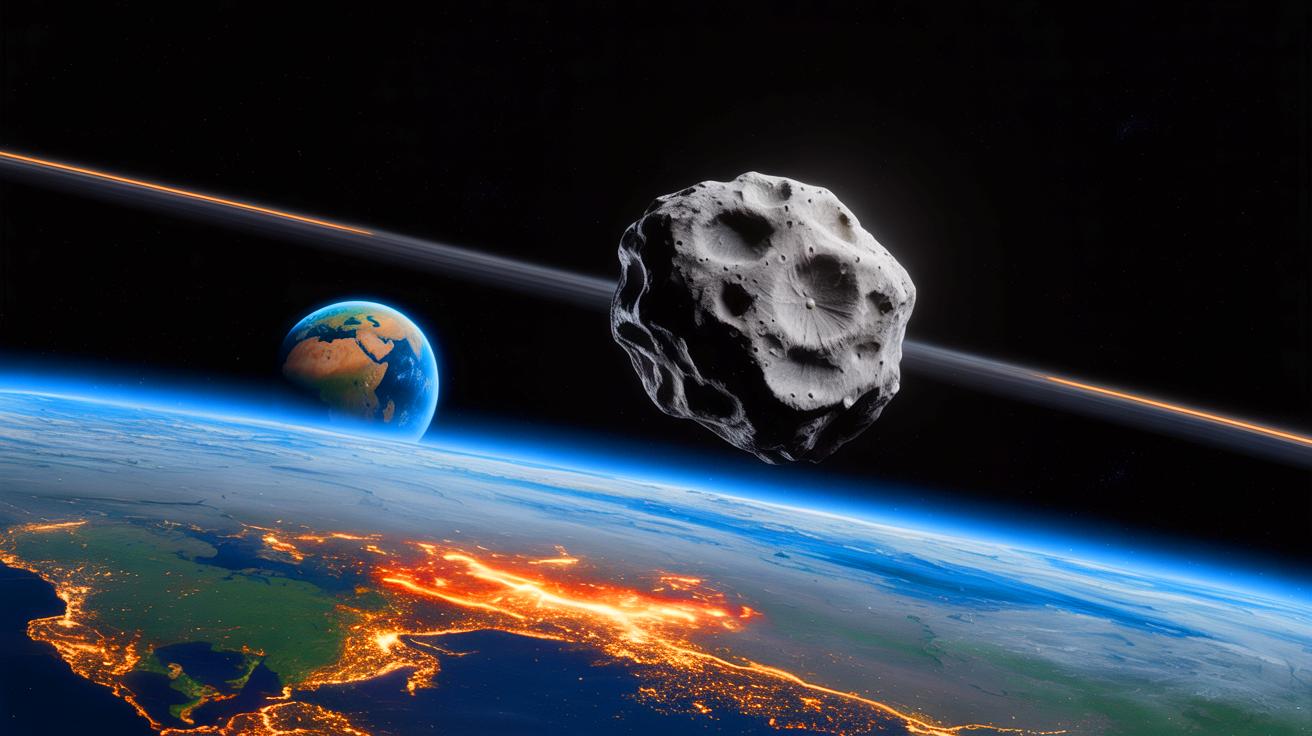
In a remarkable discovery, astronomers have confirmed the presence of a small asteroid, 2025 PN7, which has been orbiting in sync with Earth for over sixty years. Unlike our Moon, 2025 PN7 is in a unique orbit known as a quasi-satellite path. This discovery adds another fascinating layer to our understanding of the dynamic interactions between Earth, the Sun, and near-Earth asteroids. While this quasi-moon may only remain in its current path for a few more decades, it provides a valuable opportunity for scientists to study gravitational influences in our solar system. This development brings to light the intricate gravitational dance in our celestial neighborhood.
Understanding Quasi-Moons
Quasi-moons, such as 2025 PN7, present an intriguing case of orbital mechanics. These objects trail the Sun in a path that closely mirrors Earth’s orbit. While they appear to orbit Earth, they are actually under the Sun’s gravitational influence. The visible trajectories from Earth often resemble looping or corkscrew patterns, a phenomenon that can confound both amateur and professional astronomers.
The concept of quasi-moons entered the astronomical lexicon in the early 1990s with the discovery of asteroid 1991 VG. Initially mistaken for an alien probe, it opened a new chapter in understanding orbital behaviors. Since then, several quasi-moons have been identified. Among them is Kamo‘oalewa, which has been accompanying Earth for centuries and may continue to do so for many more.
2025 PN7 stands out due to its diminutive size and relative instability. Measuring only 62 feet across, it is comparable to the meteor that famously exploded over Chelyabinsk, Russia, in 2013. Its faint brightness requires powerful telescopes for observation, underscoring the challenges in detecting such small celestial bodies.
The Discovery of 2025 PN7
The journey to discovering 2025 PN7 began on August 2, 2025. Astronomers at the Haleakalā Observatory in Hawaii, utilizing the Pan-STARRS1 telescope, first spotted the asteroid. Its peculiar orbit caught the eye of Adrien Coffinet, a French journalist and amateur astronomer. Coffinet conducted calculations that suggested its status as a quasi-satellite and shared these findings with the Minor Planet Mailing List.
This sparked further investigation by researchers Carlos de la Fuente Marcos and Raúl de la Fuente Marcos at the Complutense University of Madrid. Leveraging NASA’s Jet Propulsion Laboratory Horizons system and Python-based modeling, they mapped 2025 PN7’s orbit and compared it with other known quasi-moons. Their research, published in the Research Notes of the American Astronomical Society, confirmed that 2025 PN7 has been in its quasi-satellite orbit for about 60 years and will likely remain for another 60.
The asteroid’s current orbit is expected to last a total of approximately 128 years, a shorter span compared to other quasi-moons like Kamo‘oalewa. This time frame provides scientists ample opportunity for further study and observation.
Stability and Future Trajectory
One of the primary questions surrounding 2025 PN7 is its potential threat to Earth. Current models indicate that it poses no risk. Although its orbit fluctuates in distance from Earth, it never approaches close enough to be considered dangerous.
However, the orbit of 2025 PN7 is not particularly stable. Minor influences, such as sunlight pressure or gravitational effects from other planets, can gradually alter its path. These factors complicate predictions about its future trajectory. Eventually, 2025 PN7 will exit its quasi-satellite orbit, possibly transitioning into a different co-orbital path before drifting further into space.
This instability underscores the complexity of predicting the movements of celestial bodies in our solar system. The ongoing study of 2025 PN7 will help refine models used to understand such dynamics and improve our ability to forecast the behavior of near-Earth objects.
The Importance of Studying Quasi-Moons
Quasi-moons like 2025 PN7 offer valuable insights into orbital mechanics and gravitational interactions. These objects act as natural laboratories, allowing astronomers to observe how gravitational forces influence small bodies over extended periods.
Monitoring quasi-moons also plays a critical role in planetary defense. While 2025 PN7 is not a threat, maintaining awareness of objects that linger near Earth is essential for identifying potential hazards in the future. This ongoing work sharpens the tools used in assessing and predicting asteroid threats.
Moreover, quasi-satellites hold potential for space exploration. Their prolonged proximity to Earth makes them practical targets for robotic missions. Sending probes or sample-return missions to quasi-moons could be more cost-effective than pursuing asteroids that only occasionally pass by Earth. Some researchers even speculate that these objects could be key to future asteroid mining endeavors.
The discovery of 2025 PN7 highlights the continual surprises our solar system holds. As astronomers keep a close watch on this quasi-moon, questions remain about the future of such celestial companions. How many more quasi-moons are hiding in the shadows, waiting to be discovered? As technology advances, the boundaries of our cosmic knowledge may expand further, revealing new wonders in the vastness of space.