



| IN A NUTSHELL |
|
Saturn, the majestic gas giant, has long intrigued scientists with its enigmatic atmosphere and breathtaking rings. Recent observations by the James Webb Space Telescope have unveiled peculiar patterns and structures in Saturn’s upper atmosphere, sparking interest and curiosity among astronomers. These discoveries, which present phenomena never before seen on Earth or any other planet, are poised to deepen our understanding of Saturn and potentially other celestial bodies. The findings come at a time when space exploration is advancing rapidly, offering new insights into the mysteries of our solar system and beyond.
Peering Into Saturn’s Hidden Layers
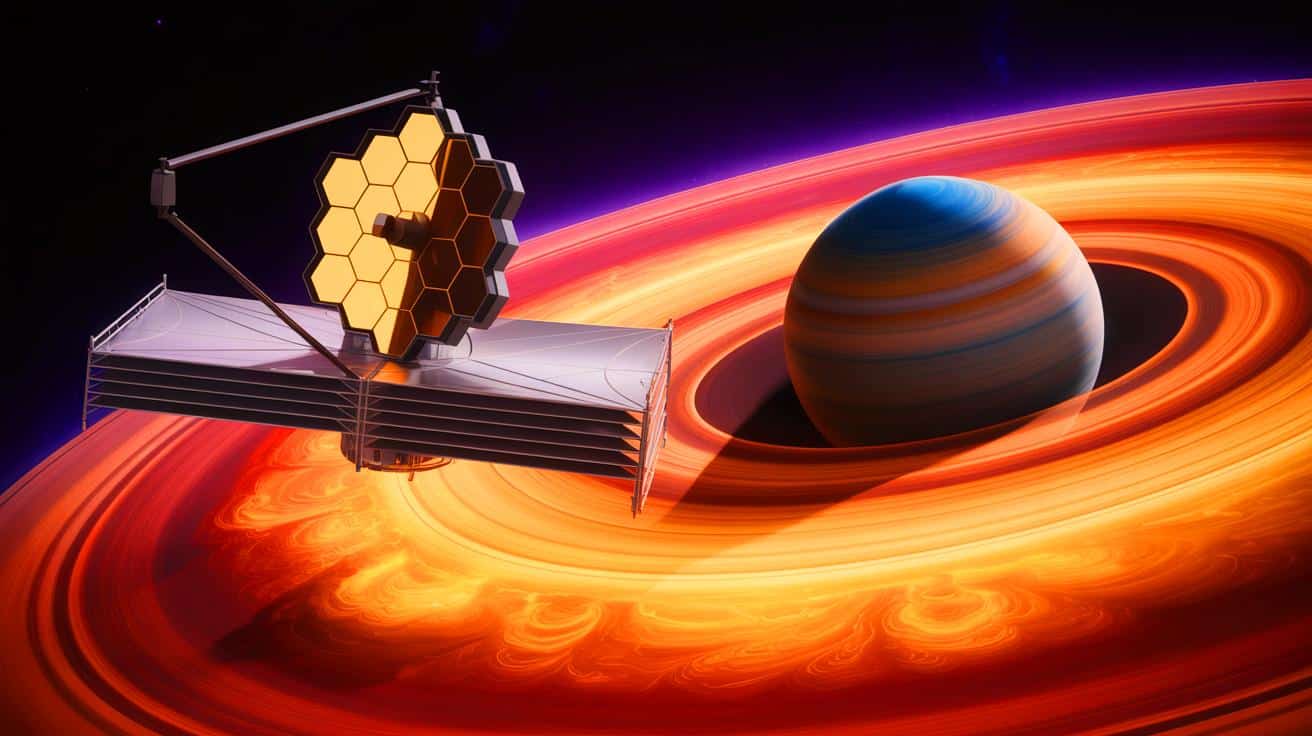
The James Webb Space Telescope has accomplished what previous missions, like the Cassini spacecraft, could not: a detailed examination of Saturn’s upper atmosphere. On November 29, 2024, Webb’s Near-Infrared Spectrograph focused on Saturn’s north pole for nearly ten hours, providing unprecedented data. By capturing over 3,600 slices of light across various wavelengths, astronomers were able to map the planet’s upper atmospheric layers with remarkable precision.
This meticulous analysis revealed unexpected phenomena, including rotating auroral features and bead-like structures in the ionosphere. These formations, along with a star-patterned dark polar cap in the stratosphere, are unlike anything observed on other planets. As Tom Stallard, a planetary scientist, remarked, these discoveries are both surprising and unexplained, challenging existing models of planetary atmospheres.
Beyond the Auroras: Internal Dynamics
Saturn’s auroras, while similar in formation to Earth’s northern lights, exhibit unique characteristics. The new data from the Webb telescope indicates that these auroral emissions are primarily influenced by Saturn’s own atmospheric dynamics, rather than external magnetic storms. This internal regulation of auroras by the planet’s winds and currents adds a complex layer to our understanding of Saturn’s atmosphere.
Additionally, the discovery of a sprawling, lopsided star pattern in the stratosphere, extending from the north pole into mid-latitudes, suggests dynamics that defy current scientific models. This unusual configuration, characterized by methane fluorescence, hints at intricate atmospheric processes that are yet to be fully understood. The peculiar absence of two arms in this four-armed star design further complicates the picture, prompting researchers to explore new theories.
The Enigma of Saturn’s Dark Beads
Among the most intriguing findings are the dark “beads” observed at latitudes between 55 and 65 degrees north. These faint pockets within bright auroral rings exhibit varying stability, with some remaining stationary over hours while others shift slightly as Saturn rotates. The beads’ presence and behavior are unprecedented, leading scientists to consider several hypotheses.
One possibility is that these beads result from turbulence as powerful winds clash, creating ripples akin to Kelvin-Helmholtz instabilities. This phenomenon could account for the bead-shaped cavities in Saturn’s ionosphere. The exceptional sensitivity of the Webb telescope has revealed these subtle features, offering a new perspective on Saturn’s atmospheric dynamics that was previously unattainable.
Connections and Global Collaboration
Saturn’s famous hexagon, a massive six-sided jet stream, also features in the recent observations. Although faint in Webb’s data, it shows flashes of alternating light and dark patches, hinting at a possible relationship with the newly discovered star pattern. The interplay between these atmospheric features remains uncertain, inviting further investigation.
This groundbreaking work is the result of a global effort involving 23 researchers from the United States, United Kingdom, France, and Japan. By combining expertise from institutions like Boston University and Imperial College London, the team has mapped structures spanning over a thousand kilometers in Saturn’s atmosphere. Such international collaboration underscores the importance of shared knowledge and resources in advancing planetary science.
A New Era of Planetary Exploration
The revelations from the James Webb Space Telescope mark a significant milestone in Saturn exploration, challenging previous assumptions and opening new avenues for research. The telescope’s ability to detect fine-scale patterns and emissions has revitalized interest in Saturn, offering insights that could inform our understanding of other gas giants, such as Jupiter and Neptune.
As scientists continue to analyze these findings, they will refine models of atmospheric behavior, enhancing our comprehension of planetary dynamics both within and beyond our solar system. In exploring the strange beads and asymmetric stars of Saturn, researchers are not only unraveling the mysteries of a distant world but also honing the tools needed to predict Earth’s changing climate and study exoplanets orbiting distant stars.
Saturn’s captivating atmosphere serves as a reminder of the vast unknowns that remain in our universe. As we uncover more about these enigmatic features, what other secrets might Saturn hold, and how might they reshape our understanding of planetary science?