




| IN A NUTSHELL |
|
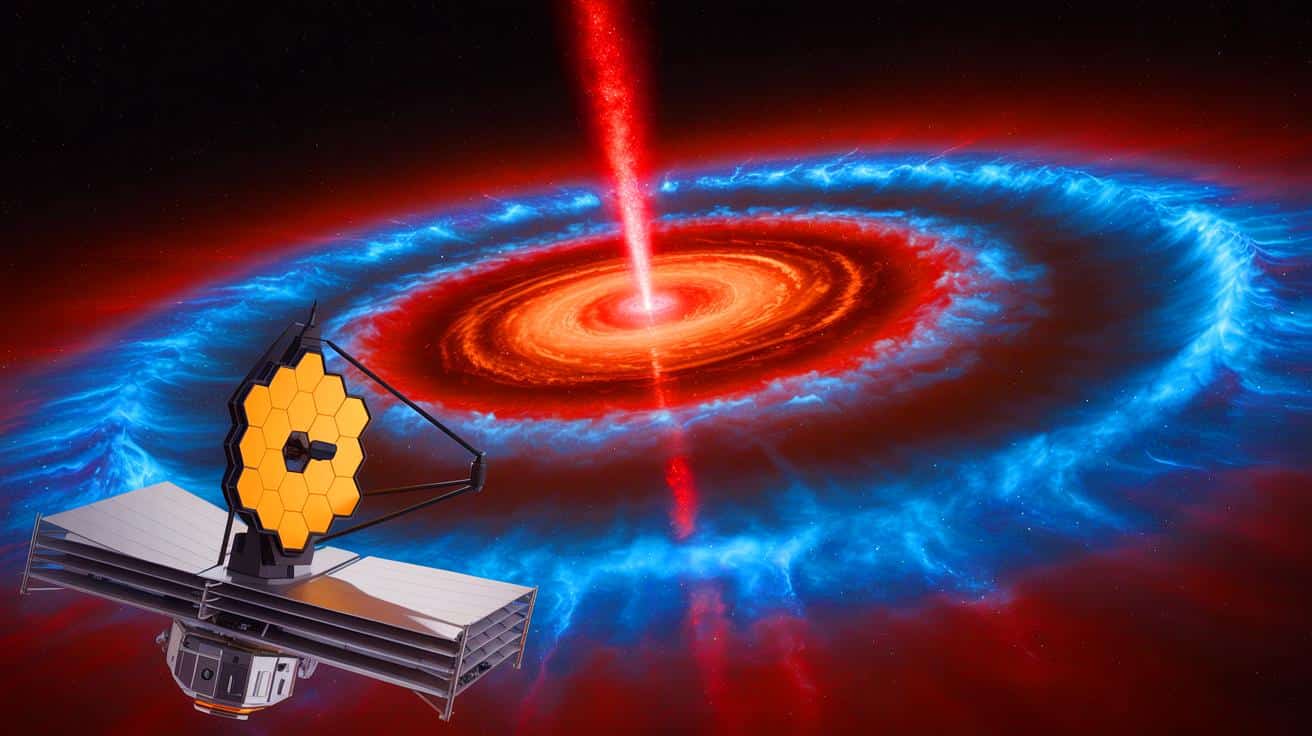
In the vast cosmos, a groundbreaking discovery is reshaping our understanding of planetary formation. Long held views suggested that water vapor was the primary component in the early stages of planet creation. However, new findings from Stockholm University, largely based on observations from the James Webb Space Telescope (JWST), challenge this belief. This pivotal study reveals that certain young planet-forming disks are dominated by carbon dioxide rather than water. Such revelations could have profound implications for our understanding of how Earth-like planets form and evolve. The discovery invites scientists to reconsider the chemical processes that drive the birth of new worlds.
Unveiling the Role of Carbon Dioxide in Planet Formation
When stars are born, they are often surrounded by swirling disks of gas and dust. These disks serve as the cradle for planet formation. Traditionally, it was believed that water vapor played a central role in this process. As the star heats the disk, ice-covered particles migrate inward, turning into water vapor. This vapor then becomes integral to the formation of new planets. However, the recent study led by Jenny Frediani from Stockholm University presents a surprising deviation from this model.
The team identified a young disk abundant in carbon dioxide, located in the NGC 6357 star-forming region. This region is known for its massive star production, and the discovery of a CO₂-rich disk here is unexpected. While water vapor is usually prominent near young stars, this particular disk shows an almost complete absence of it. “Unlike most nearby planet-forming disks, where water vapor dominates the inner regions, this disk is surprisingly rich in carbon dioxide,” says Frediani, emphasizing the uniqueness of their findings.
Such high levels of carbon dioxide relative to water challenge existing models of disk chemistry and evolution. These findings suggest that factors like intense ultraviolet radiation from nearby stars could be altering the chemical composition of these disks, preventing water from forming and allowing CO₂ to dominate. This revelation urges scientists to re-evaluate the existing theories about planet formation.
Isotopic Clues to Our Solar System’s History
The presence of isotopologues, or rare forms of carbon dioxide containing uncommon isotopes of carbon or oxygen, adds another layer of intrigue to this discovery. These isotopic fingerprints could be crucial in unraveling the history of our own Solar System. Similar isotopic patterns have been found in meteorites and comets, raising questions about their origins.
By studying these isotopic signatures in distant disks, researchers hope to gain insights into the early conditions of our solar neighborhood. The CO₂-rich disk, located about 33 quadrillion miles from Earth, provides a unique opportunity to study these ancient chemical markers. Despite the vast distance, the clarity of the data gathered by the JWST allows for detailed analysis.
Isotopes act as a time capsule, offering glimpses into the chemical environment of young planetary systems. By comparing these distant isotopic signatures with those found on Earth and other solar bodies, scientists aim to piece together a more comprehensive history of our Solar System’s formation.
The Transformative Role of the James Webb Space Telescope
The James Webb Space Telescope, particularly its Mid-Infrared Instrument (MIRI), has been instrumental in this discovery. MIRI’s ability to see through dense cosmic dust and capture infrared light makes it ideal for studying planet-forming disks. It functions both as a camera and spectrograph, enabling scientists to identify the chemical composition of distant cosmic objects.
MIRI’s advanced capabilities allow researchers to detect gases such as CO₂ and water vapor. Its coronagraph further facilitates the observation of smaller celestial bodies by blocking out bright starlight. The data collected by MIRI has provided unprecedented insights into the chemical makeup of planet-forming environments.
Developed with contributions from Stockholm University and Chalmers University, MIRI has opened new avenues for understanding the diversity of planetary atmospheres. By examining disks in various environments, scientists can discern how the conditions of a planet’s birth affect its development. This understanding is crucial for determining a planet’s potential habitability.
Implications for Future Planetary Science
The discovery of a CO₂-rich disk marks a new chapter in planetary science. It suggests that planets with high levels of carbon dioxide in their atmospheres might be more common than previously thought. This has significant implications for the search for extraterrestrial life, as planets with different starting conditions may exhibit unique atmospheric and surface characteristics.
This finding also prompts a re-examination of our own Solar System. Understanding why Earth is water-rich while Venus and Mars are not could offer new insights into planetary evolution. Questions about whether radiation stripped these planets of their water or if they formed from chemically distinct disks remain pertinent.
The research conducted by Stockholm University is just the beginning. As more data is collected, scientists will be better equipped to update existing models and theories. The work of the James Webb Space Telescope promises to continue shedding light on the complex processes that govern planetary formation and habitability.
As we move forward, the scientific community faces compelling questions about the nature of planetary systems. What other surprises do the cosmos hold about the origins of planets and their potential to harbor life? These inquiries remain at the heart of ongoing exploration and discovery.


Wow, this article really blew my mind! 💨 I never thought CO2 could be so important in space. Who knew?
Wow, this changes everything we thought we knew about planet formation! 🤯
Does this mean water isn’t as important for planet formation as we thought?
Great discovery! But how does this affect our understanding of Earth-like planets?
Thank you for the article, it was very enlightening!
I’m skeptical. How can CO2 be more important than water? 🤔
Wait, so are we saying that water isn’t as important for planet formation as we thought? 🤔
Isn’t CO2 considered a greenhouse gas? How does that affect planet formation?
This is fascinating, but what about methane? Could it play a role too?
Thanks for this enlightening read! I love learning how the James Webb Space Telescope is changing astronomy.
Do you think this discovery will change how we look for life on other planets?
Interesting findings, but does this mean we’re going to find more planets with atmospheres like Venus?
Great read! The James Webb Space Telescope is really proving its worth. 🌌
I need to read more about isotopologues. Never heard of them before!
Is there any chance that our own Solar System formed from a CO2-rich disk as well?
How does this finding affect the search for extraterrestrial life?