




| IN A NUTSHELL |
|
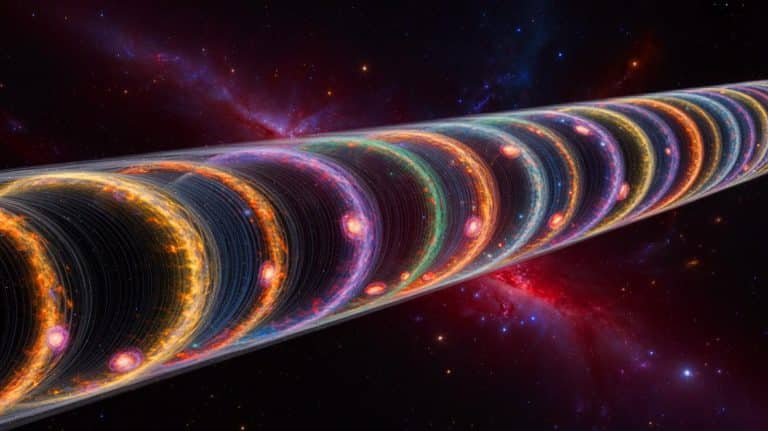
The discovery of time crystals marks a groundbreaking development in the field of quantum physics. Unlike traditional crystals that form in space, these time crystals emerge in time, pulsing with their own rhythm. This phenomenon challenges our conventional understanding of time and order, depicting a world where time itself becomes structured. The recent discovery of two new types of continuous time crystals by researchers in Vienna reveals that these structures can form spontaneously, without external influence, highlighting the deeply quantum nature of time.
From Space to Time
Traditionally, the concept of a crystal conjures images of solid materials like diamonds or quartz, where atoms are arranged in a repeating lattice. This order emerges as a liquid freezes, breaking its symmetry and establishing a uniform pattern. For years, physicists have pondered whether a similar process could occur with time. Could a quantum system, initially identical from one moment to the next, spontaneously develop a natural rhythm without any external intervention?
This question has been the subject of scientific debate for over a decade. Now, thanks to detailed models, researchers have demonstrated that time crystals are not just theoretical possibilities but can exist under certain conditions. These models show that time itself can become ordered in a surprising way, offering new insights into the nature of time and symmetry.
Correlations between quantum particles result in a rhythmic signal, without the need for an external beat to set the tempo.
A Quantum Rhythm
Felix Russo, a doctoral researcher, explains that time crystals can form without any external rhythm imposed on them. Contrary to earlier beliefs that quantum fluctuations would prevent such formations, it turns out that these fluctuations play a crucial role in stabilizing the time rhythms. Quantum mechanics, often associated with noise and randomness, surprisingly supports the emergence of these oscillations.
Instead of disrupting order, the inherent unpredictability of quantum mechanics sustains it. This revelation changes the way scientists understand the interplay between order and chaos at the quantum level. The seemingly erratic behavior of quantum particles, once seen as a barrier to stability, is now recognized as a key factor in maintaining the rhythm of time crystals.
Building the Model
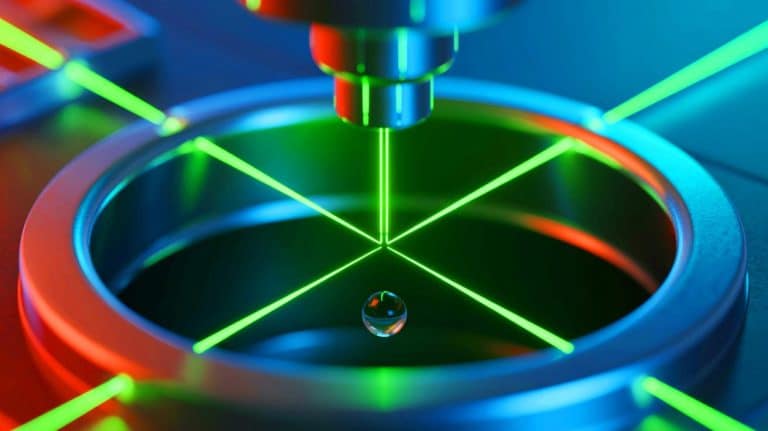
The researchers ventured into this study by examining a lattice of particles capable of existing in three states: a ground state, an intermediate level, and an excited “Rydberg” state. These states were interconnected by lasers, and the particles interacted based on proximity. This setup, known as a Rydberg atom array, is a popular tool for exploring quantum phenomena, including magnetism and entanglement.
The scientists aimed to determine whether the system could spontaneously develop a natural beat, oscillating between states without external prompting. They discovered that energy dissipation, often seen as a hindrance, actually facilitated the process by helping the system maintain its oscillatory cycles.
Dissipation, energy leaking out of the system, turned out to be important too. Instead of stopping the rhythm, this energy loss helped balance the system, leading to repeating cycles of activity.
Two Unexpected Phases
The researchers were surprised to find not one, but two distinct oscillatory phases. The first phase, known as qCTC-I, resembled a time crystal adjusted for quantum effects, aligning with earlier theories. However, it remained stable even when real-world quantum fluctuations were considered.
The second phase, qCTC-II, was entirely unexpected. It emerged solely due to quantum correlations: interactions between particles that cannot be explained by average behavior alone. This phase introduced a new dynamic where rhythm did not depend on long-range order, illustrating a novel phase that exists purely because of quantum mechanics.
The qCTC-II phase naturally suppresses energy loss, making it especially stable in practice.
Why Three States Matter
The emergence of these time-crystal phases was contingent on systems with three particle states, known as spin-1 systems. Simpler systems with only two levels did not exhibit the effect, suggesting that additional complexity is necessary to realize time crystals.
This finding raises intriguing questions about the minimum requirements for time crystals and whether other platforms, such as molecules or solid-state materials, could host similar structures. Researchers are eager to investigate these possibilities, expanding the scope of time crystal research.
Experiments on the Horizon
One of the most exciting aspects of this research is its experimental potential. The parameters used in the models are within reach of current laboratory capabilities. With advancements in Rydberg atom experiments, scientists anticipate real tests of the qCTC-I and qCTC-II phases in the near future.
The qCTC-II phase, with its natural suppression of energy loss, could prove particularly stable in experimental settings. This stability offers researchers the opportunity to observe time symmetry breaking in action, demonstrating that time can crystallize through quantum effects alone.
The discovery of time crystals opens new vistas in the field of quantum physics, challenging preconceived notions of time and symmetry. As researchers continue to explore these phenomena, the implications for quantum technology are vast, from improved clocks to innovative memory systems. How will these developments shape our understanding of the quantum world and the very fabric of time itself?