



| IN A NUTSHELL |
|
Solar storms, while often unnoticed by the general public, have the potential to cause significant disruptions on Earth. These storms, primarily caused by coronal mass ejections (CMEs), can interfere with satellite operations, disrupt GPS systems, and even affect power grids. Recent research from the University of Michigan has provided new insights into the nature of these storms, revealing complex magnetic structures that resemble cosmic tornadoes. By understanding these hidden twists, scientists hope to improve predictions and mitigate the impacts of solar storms on our increasingly technology-dependent world.
Hidden Twisters in Solar Storms
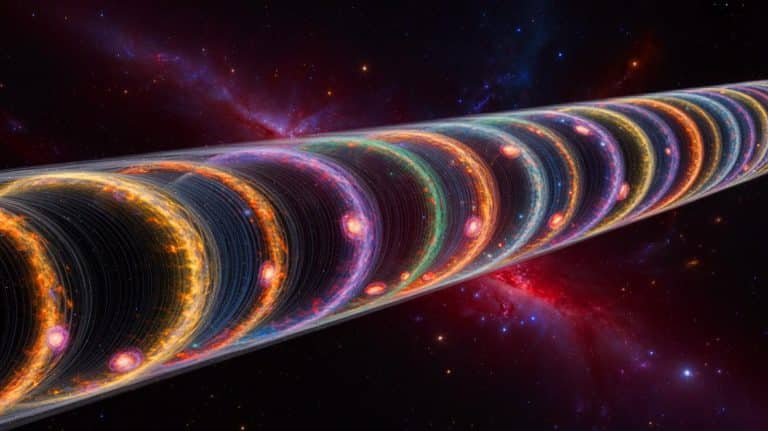
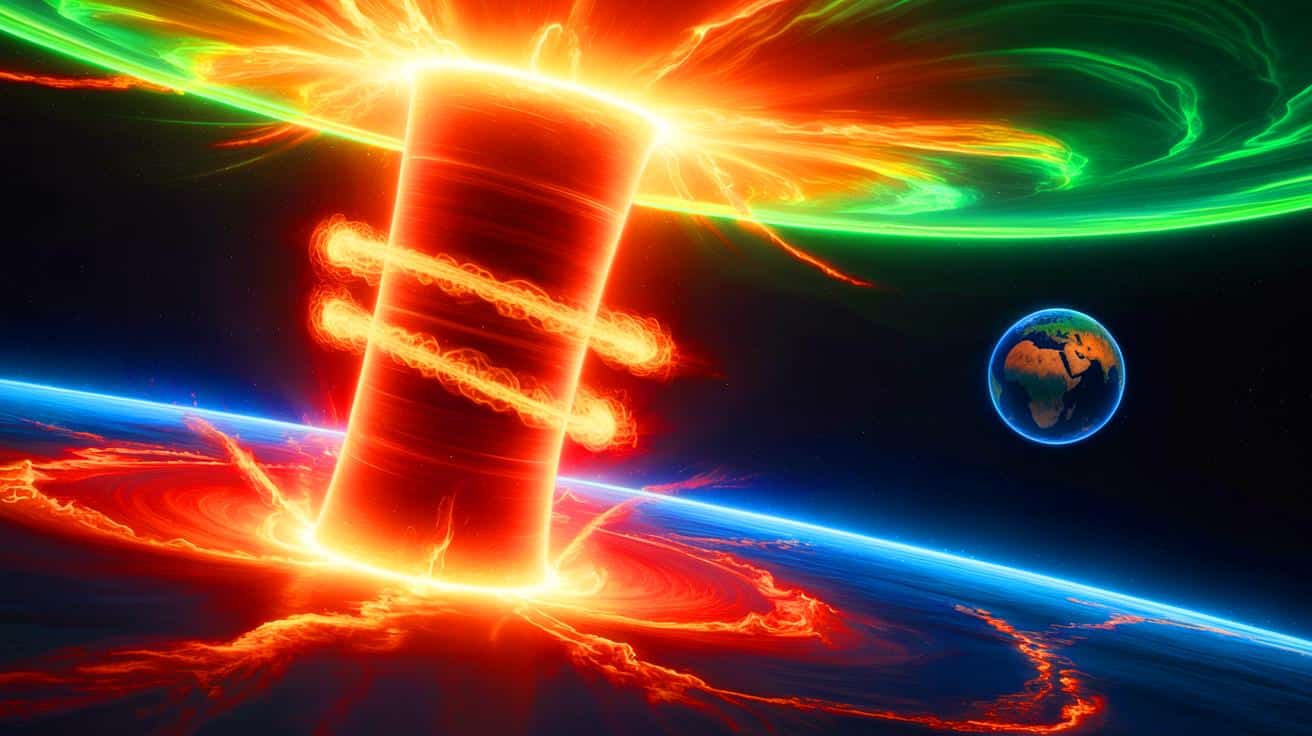
Coronal mass ejections are massive bubbles of electrically charged gas expelled from the Sun. When these CMEs burst, they contain magnetic fields that stretch millions of miles into space. However, new high-resolution computer simulations have shown that these CMEs are more complex than previously thought. Instead of being simple bubbles of plasma, they contain a chaotic mess of magnetic “flux ropes,” tightly coiled loops that act like tornadoes in space.
These flux ropes can have a significant impact on Earth’s magnetic field. According to William “Chip” Manchester, a research professor at the University of Michigan, these vortices have magnetic fields strong enough to cause geomagnetic storms. These storms can lead to real-world problems, such as disrupting satellite electronics and interfering with power grids.
In 2014, Manchester’s team mimicked a solar outburst and discovered a chaotic inner universe within the CME. Magnetic lines wrapped around each other, unraveled, and re-threaded, a process known as magnetic reconnection. This constant reshuffling produced small spinning magnetic knots inside the larger CME, each with its own potential to cause disruption.
A Model That Traces the Mayhem
To better understand these hidden forces, the research team used the Alfvén Wave Solar Atmosphere Model. This model allowed them to map the energy from the Sun’s surface into the solar wind, which is the constant stream of particles flowing through space. When the simulated explosion collided with the slower-moving solar wind, it created a tempest of magnetic twists and turns.
Some of these small storms dissipated quickly, but others persisted across millions of miles, forming clusters of stable magnetic whirlpools. These structures can trap charged particles and enhance local magnetic fields, similar to how weather fronts behave in Earth’s atmosphere.
Previous models of CMEs depicted them as basic, balloon-shaped clouds. The latest research, however, reveals that they are more like tangled skeins of yarn, filled with small storms that can alter the overall impact once they reach Earth.
Why These Twists Matter
Flux ropes may seem like a minor detail, but they are key to understanding how solar storms affect Earth. When a magnetic knot points south, opposite to Earth’s magnetic field, it can create a pathway for energy to enter our magnetosphere. This can result in spectacular auroras or potentially harmful spikes in electricity grids.
Because many of these hidden structures form away from the Sun, they cannot be detected with telescopes. Current warning systems rely on single satellites in fixed orbits, providing only a limited view of solar winds. As co-author Mojtaba Akhavan-Tafti points out, it’s like trying to track a hurricane with a single wind gauge.
To improve predictions, scientists must actively search for these Earth-based flux ropes rather than relying solely on observations of the Sun. This involves developing new technologies and approaches to monitor space weather more comprehensively.
A Constellation to Catch Solar Tornadoes
To address this challenge, the research team proposes the Space Weather Investigation Frontier (SWIFT), a new generation of spacecraft designed to monitor solar storms. The SWIFT constellation would consist of four probes flying in a pyramid configuration about 200,000 miles apart. This setup would provide a three-dimensional view of solar storms, allowing scientists to track their magnetic twists and predict their impacts.
The central hub of the constellation would be positioned slightly closer to the Sun than current warning satellites, offering warnings up to 40% sooner. Keeping this hub steady would be challenging, as it would require overcoming the Sun’s gravity. However, engineers have devised a solution: a shiny aluminum sail developed through NASA’s Solar Cruiser mission. This sail would use sunlight for propulsion, enabling the space telescope to remain stationary without consuming fuel.
Bridging the Gap Between Models and Reality
This research stands out because it combines detailed physics simulations with real spacecraft measurements. Earlier missions, such as Solar Orbiter and BepiColombo, have observed weaker flux ropes in space, consistent with the Michigan model’s predictions. These findings help explain why spacecraft sometimes record puzzling magnetic flips and energy bursts during a CME. Such readings may not be chaotic turbulence but rather observations of these mesoscale structures.
By simulating these effects, the research bridges the gap between theoretical models and real-world observations, providing a clearer picture of the complex interactions between the Sun and Earth.
The study of solar storms is not just an academic pursuit. Our modern civilization relies heavily on technology that can be disrupted by extreme space weather events. Understanding the true nature of solar storms is crucial for protecting our infrastructure and ensuring the continued functionality of satellites, power grids, and communication systems. As the Sun approaches another peak in its 11-year cycle, how can we further improve our ability to predict and respond to these cosmic events?