



| IN A NUTSHELL |
|
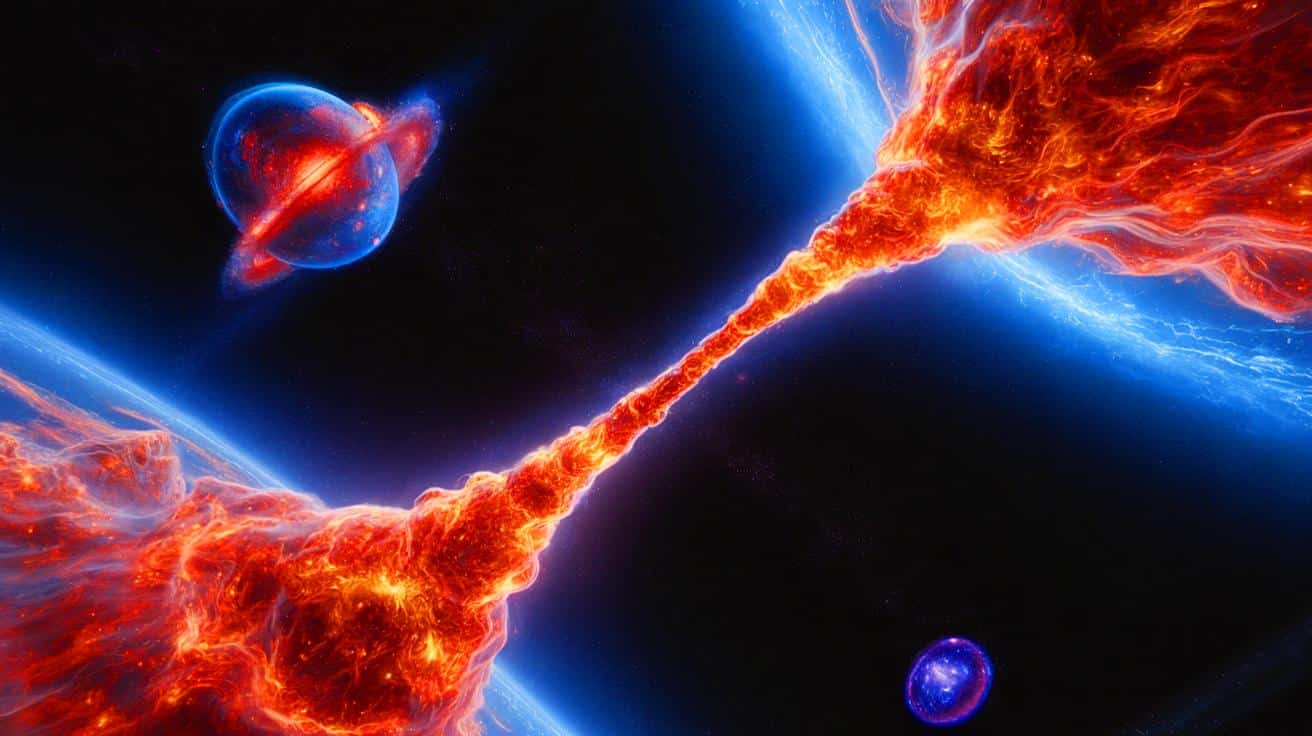
Astronomers have recently observed a staggering 50-million-light-year-long flow of hydrogen gas connecting two dwarf galaxies, NGC 4532 and DDO 137. This discovery, made using the ASKAP radio telescope in Western Australia, offers a rare glimpse into how galaxies interact and evolve over billions of years. The gas bridge, extending approximately 185,000 light-years, along with a massive tail of gas stretching 1.6 million light-years, provides key insights into the cosmic forces at play. This remarkable find is part of an ongoing effort to map hydrogen, the universe’s most abundant element, and understand its role in galactic dynamics and star formation.
A Cosmic Conversation
The discovery of the hydrogen gas bridge forms part of the Widefield ASKAP L-band Legacy All-sky Survey (WALLABY). This ambitious project aims to map the distribution of hydrogen gas across the universe to better understand its interactions within galaxies. The ASKAP radio telescope, one of the world’s most sensitive, was instrumental in detecting the faint hydrogen emissions connecting NGC 4532 and DDO 137. Hydrogen is not only the raw material for stars but also a crucial determinant of a galaxy’s fate. It can dictate whether a galaxy will expand and form new stars or wither away over time.
The observations reveal galaxies seemingly in conversation, their interactions driven by complex gas dynamics. Professor Lister Staveley-Smith explains, “It’s like capturing galaxies during the act of talking with each other.” The gravitational pull between these galaxies and their proximity to the massive Virgo cluster are key elements influencing the observed gas dynamics. This discovery helps astronomers understand the intricate relationships between galaxies and the forces that shape them.
Stripping Gas Across Billions of Years
The enormous gas structures observed have been attributed to two primary forces. The first, tidal forces, result from the gravitational pull exerted as the galaxies orbit each other. The second, ram pressure, occurs when galaxies collide with the hot, thin gas that fills the space within and around galaxy clusters. The conditions in the Virgo cluster are extreme, with gas temperatures reaching about 200 times hotter than the Sun’s surface. As NGC 4532 and DDO 137 entered this environment, their own gas began to strip away, akin to a storm stripping paint.
This process is reminiscent of a satellite burning up upon entering Earth’s atmosphere, but on a cosmic scale spanning billions of years. By examining electron density and galaxy velocity, scientists confirmed the removal of sufficient material to account for both the bridge and the colossal gas tail. These findings underscore the dynamic nature of galaxy interactions and the complex forces at play.
A Connection to Our Own Backyard
While the observed phenomena occur in a distant cosmic region, their implications resonate closer to home. Our Milky Way galaxy also hosts satellite galaxies, the Magellanic Clouds, connected by similar hydrogen gas structures. These bridges offer valuable insights into how our galaxy interacts with its neighbors and the role of hydrogen in star formation. Professor Kenji Bekki emphasizes the importance of these observations, stating, “Neutral hydrogen plays a central part in starbirth, so seeing how it’s remixed is crucial to understanding how galaxies are formed.”
The new findings provide a natural laboratory for testing theories of gas flow, heating, and mixing within the intergalactic medium. This information is vital for understanding the conditions that foster or hinder star formation, shedding light on the broader evolutionary processes of galaxies. As researchers delve deeper into these cosmic connections, our understanding of the universe’s intricate tapestry continues to grow.
Unraveling the Larger Tapestry
The ongoing WALLABY survey is a testament to the power of large-scale astronomical studies in unraveling the mysteries of the universe. By examining hydrogen flows across vast distances, astronomers piece together the cosmic jigsaw puzzle of galaxy formation and evolution. In crowded regions like galaxy clusters, galaxies are far from isolated entities; they engage in a cosmic dance, exchanging gas and influencing each other’s fate.
This “breathing” of galaxies over cosmic time scales determines whether they will shine with new generations of stars or fade into obscurity. The integration of radio and optical data mapping hydrogen flows offers a comprehensive view of galactic interactions. As Professor Staveley-Smith notes, “Understanding these bridges and their dynamics gives us an important insight into how galaxies evolve over time, how galactic gas is cycled, and the conditions under which stars do or don’t form.”
Practical Implications of the Research
Tracking hydrogen gas trails on these scales provides astronomers with crucial data to understand galaxy evolution and transformation. This information feeds into computer simulations of the universe’s development, enabling scientists to test theories about star formation and galactic structure. Closer to home, these observations offer insights into the Milky Way’s past and future interactions with neighboring galaxies. As our galaxy experiences its own cosmic encounters, lessons from distant systems provide a blueprint for understanding our galactic neighborhood.
In a broader context, understanding how star-forming material is distributed is essential for the existence of planets and life itself. As astronomers continue to explore the cosmos, the question remains: How will future discoveries reshape our understanding of galaxy dynamics and the universe’s grand design?