



| IN A NUTSHELL |
|
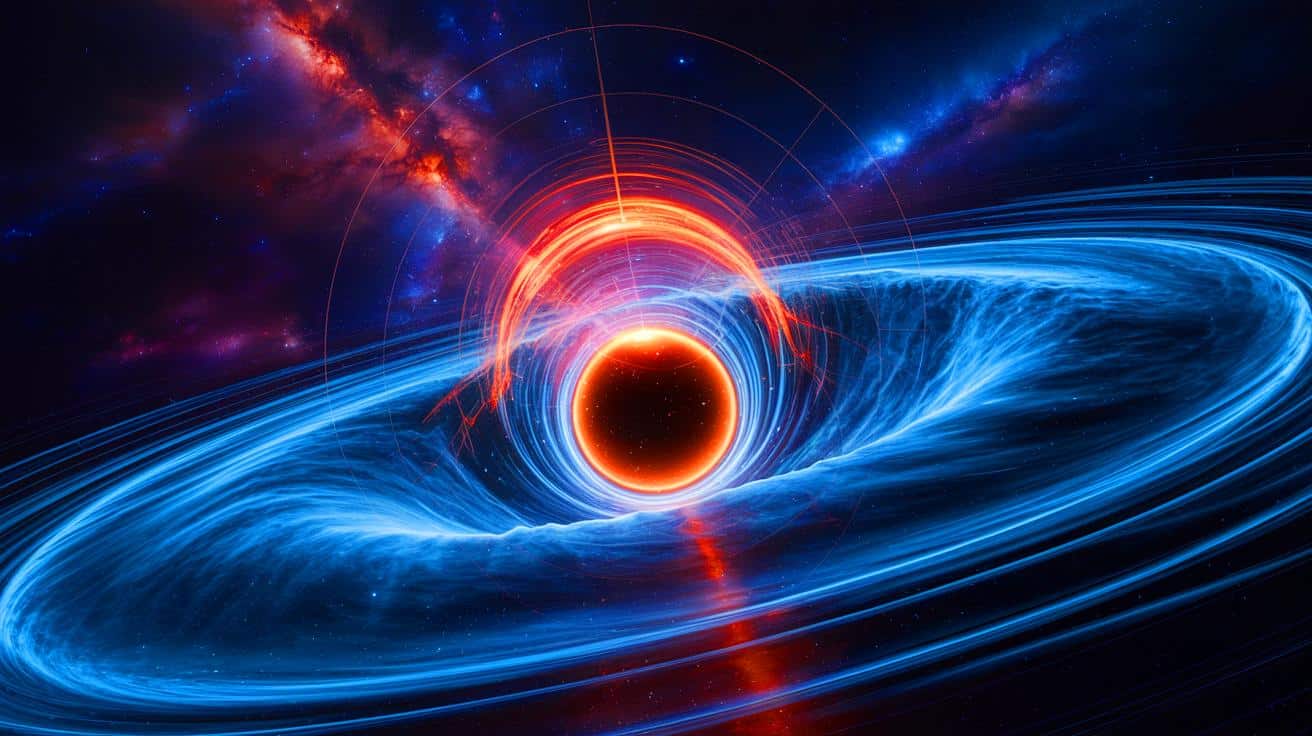
In May 2019, an unusual event was captured by the LIGO and Virgo detectors, marking a significant moment in the study of gravitational waves. The event, known as GW190521, lasted only a fraction of a second and diverged from the typical “chirps” associated with black hole collisions. Instead, it presented as a brief, intense signal that intrigued scientists. Initially, researchers concluded that the event was the result of the merger between two massive black holes, yet this explanation faced skepticism due to the “forbidden gap” in astrophysics. This gap challenges the existence of black holes of such mass, prompting scientists to explore alternative theories.
Theories Behind GW190521
The initial explanation for GW190521’s signal involved the merger of two massive black holes. One was about 85 times the mass of the Sun, and the other about 66 times. This merger resulted in the creation of a new black hole with a mass of approximately 142 solar masses. This event was notable as it marked the first observation of intermediate-mass black holes. However, this explanation raised questions in the astrophysics community due to the “forbidden gap,” which suggests that stars large enough to form such black holes should not exist. This contradiction has led to further investigation and the consideration of other possibilities.
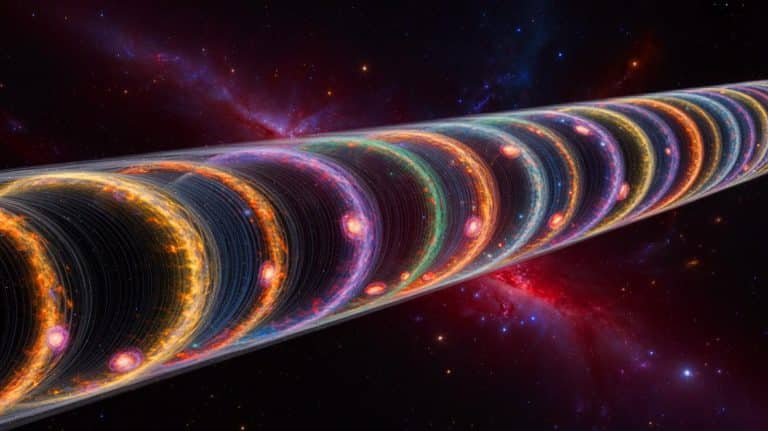
One provocative alternative proposes that the signal could be an echo from a different universe. This theory is rooted in the concept of wormholes, theoretical passages through spacetime that could connect different universes. While still speculative, the idea challenges conventional understanding and prompts a reevaluation of the events surrounding GW190521.
Exploring the Wormhole Hypothesis
A group of Chinese physicists has put forward the bold hypothesis that GW190521 might be the result of a wormhole echo. In this scenario, the gravitational wave detected would be a “ringdown” echo from a black hole merger in another universe, transmitted through a wormhole into our own. The concept relies on the Morris-Thorne model of wormholes, which imagines them as tunnels through spacetime. Although no wormholes have been observed to date, they remain a tantalizing possibility in theoretical physics.
The researchers applied a sine-Gaussian signal model to the GW190521 data, aligning it with the observed characteristics of the event. Their findings suggest a surprising match, with the signal frequency and duration aligning closely with what would be expected from such a wormhole echo. While this theory is far from proven, it presents a fascinating alternative to the traditional black hole merger explanation.
Comparing Competing Models
To evaluate the wormhole hypothesis, scientists compared it to the established black hole merger model. Using Bayesian statistics, they assessed the likelihood of each explanation. The results showed that while the black hole merger model slightly edged out the wormhole hypothesis in terms of statistical favorability, the latter could not be entirely dismissed. Both models demonstrated a similar signal-to-noise ratio across the LIGO and Virgo detectors, suggesting that further investigation is warranted.
The possibility of wormholes implies a connection to quantum gravity theory, a field that explores the fundamental nature of spacetime and gravity. If GW190521 were indeed a wormhole echo, it would have profound implications for our understanding of the universe. However, significant challenges remain, such as the need for negative energy matter to sustain a wormhole: a substance that has yet to be observed.
Implications and Future Research
The potential discovery of a wormhole through GW190521 would revolutionize our understanding of the universe. It would not only validate aspects of quantum gravity theory but also open up new avenues for exploring the nature of spacetime and the possibility of other universes. However, the challenges are immense, and current scientific tools may not yet be equipped to provide definitive answers.
Moving forward, researchers aim to refine waveform templates and enhance the sensitivity of detectors. As gravitational wave astronomy advances, it may offer new insights into the mysteries of the universe. The study of GW190521 serves as a reminder of how much remains to be discovered and the exciting potential that lies in future explorations. What new revelations might the universe hold as our technological capabilities and theoretical frameworks continue to evolve?