



| IN A NUTSHELL |
|
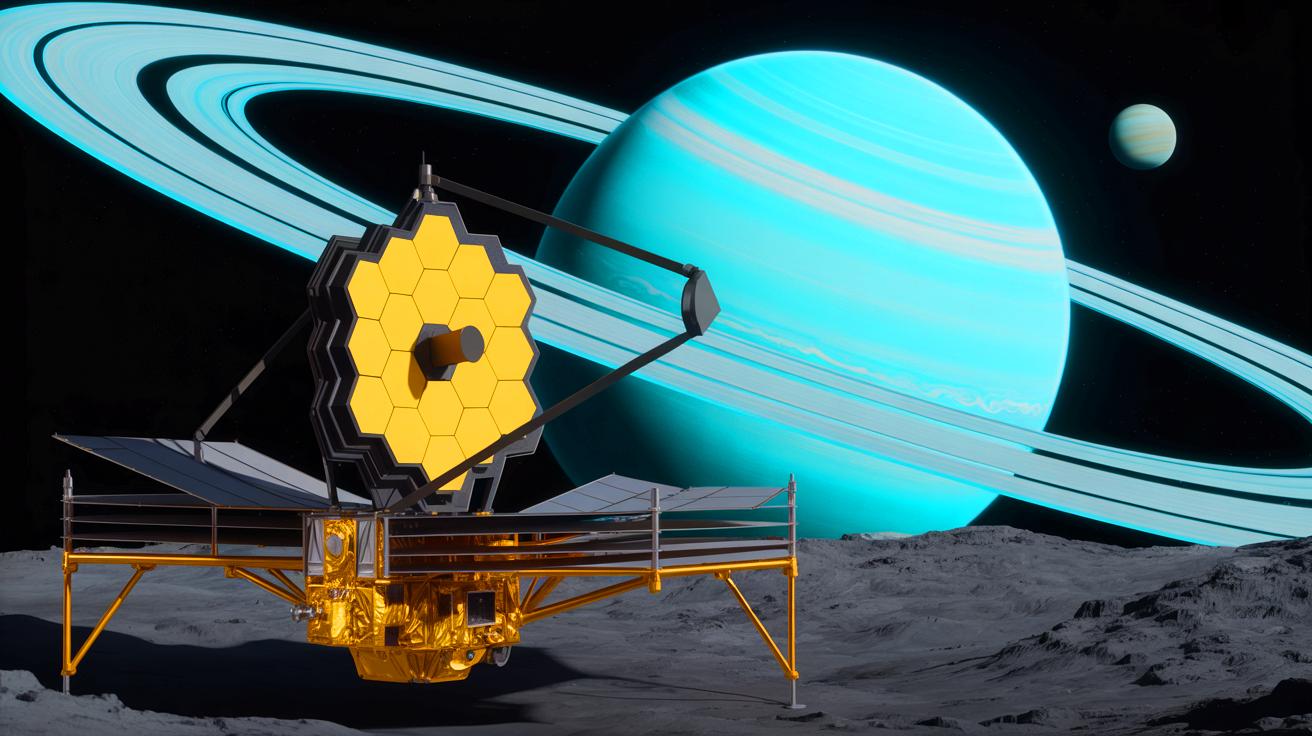
In an exciting development, the James Webb Space Telescope has identified a new moon orbiting Uranus, an icy giant known for its intriguing tilt and faint ring system. This recent addition, temporarily named S/2025 U1, brings the total count of Uranus’ moons to 29. This discovery, made by the Southwest Research Institute, underscores the telescope’s remarkable capabilities in uncovering celestial bodies that have remained elusive for decades. The finding not only enriches our understanding of Uranus but also highlights the potential for further discoveries in the outer solar system.
A New Addition to Uranus’ Moons
The newly discovered moon, S/2025 U1, was first observed on February 2, 2025. Utilizing the James Webb Space Telescope’s Near-Infrared Camera, researchers captured this small celestial body in a series of ten 40-minute long-exposure images. This meticulous process enabled scientists to detect the faint light reflected by the moon, which had eluded detection during the Voyager 2 flyby in 1986.
Voyager 2, the only spacecraft to have flown past Uranus, lacked the sensitivity required to spot such a tiny object. Maryame El Moutamid from the Southwest Research Institute notes that this discovery is significant despite the moon’s small size. The ability to detect S/2025 U1 highlights advancements in astronomical technology, opening new avenues for the study of our solar system’s more obscure bodies.
Characteristics of the Hidden Moon
With a diameter of just six miles, S/2025 U1 is minuscule compared to Uranus’ largest moons, such as Titania and Oberon. The moon’s diminutive size and low brightness made it nearly invisible to previous telescopes. Positioned approximately 35,000 miles from Uranus’ center, it orbits between the paths of moons Ophelia and Bianca.
The moon’s nearly circular orbit suggests it may have formed in its current location, rather than being captured later. This places S/2025 U1 among the 14 inner moons orbiting closer to Uranus. Matthew Tiscareno of the SETI Institute points out that Uranus boasts more small inner moons than any other planet, hinting at a chaotic history that blurs the boundary between its ring system and its moons.
Webb’s Expanding Astronomical Reach
The discovery of S/2025 U1 exemplifies the James Webb Space Telescope’s impressive capabilities. While renowned for its study of distant galaxies, Webb’s infrared sensitivity also enables it to investigate faint and distant objects within our solar system. El Moutamid emphasizes that this discovery was part of Webb’s General Observer program, which supports global scientific collaboration.
This breakthrough builds on the legacy of earlier missions like Voyager 2, highlighting how modern astronomy continues to advance our understanding of the cosmos. Nearly four decades after Voyager 2’s encounter with Uranus, the James Webb Space Telescope is pushing the boundaries of what we know about our solar system.
Uranus: An Enigmatic World
Uranus, the seventh planet from the Sun, remains one of the lesser-studied celestial bodies in our solar system. Discovered in 1781 by Frederick William Herschel, Uranus orbits the Sun at a staggering distance of 1.8 billion miles. Despite its immense size, Uranus often appears as a faint, featureless sphere in telescopic images.
The planet’s pale blue-green hue results from methane gas in its atmosphere, while its narrow and dark rings hint at a complex past. The discovery of another moon adds to the evidence that Uranus’ environment is dynamic and possibly unstable. As researchers continue to explore this distant world, each new finding sheds light on its intricate systems.
Moons Around Each Planet (as of 2025)
| Planet | Number of Moons |
|---|---|
| Mercury | 0 |
| Venus | 0 |
| Earth | 1 |
| Mars | 2 |
| Jupiter | 97 |
| Saturn | 274 |
| Uranus | 29 |
| Neptune | 16 |
The identification of a new moon around Uranus highlights the vast unknowns still present in our solar system. Discoveries like these emphasize the importance of continued exploration and observation. The presence of such small moons could reshape our understanding of how planetary systems form and evolve, offering insights into Earth’s own history.
As humanity delves deeper into the mysteries of space, each new finding presents opportunities for scientific advancement and discovery. What other secrets does the universe hold, waiting to be uncovered by the next generation of astronomers?