



| IN A NUTSHELL |
|
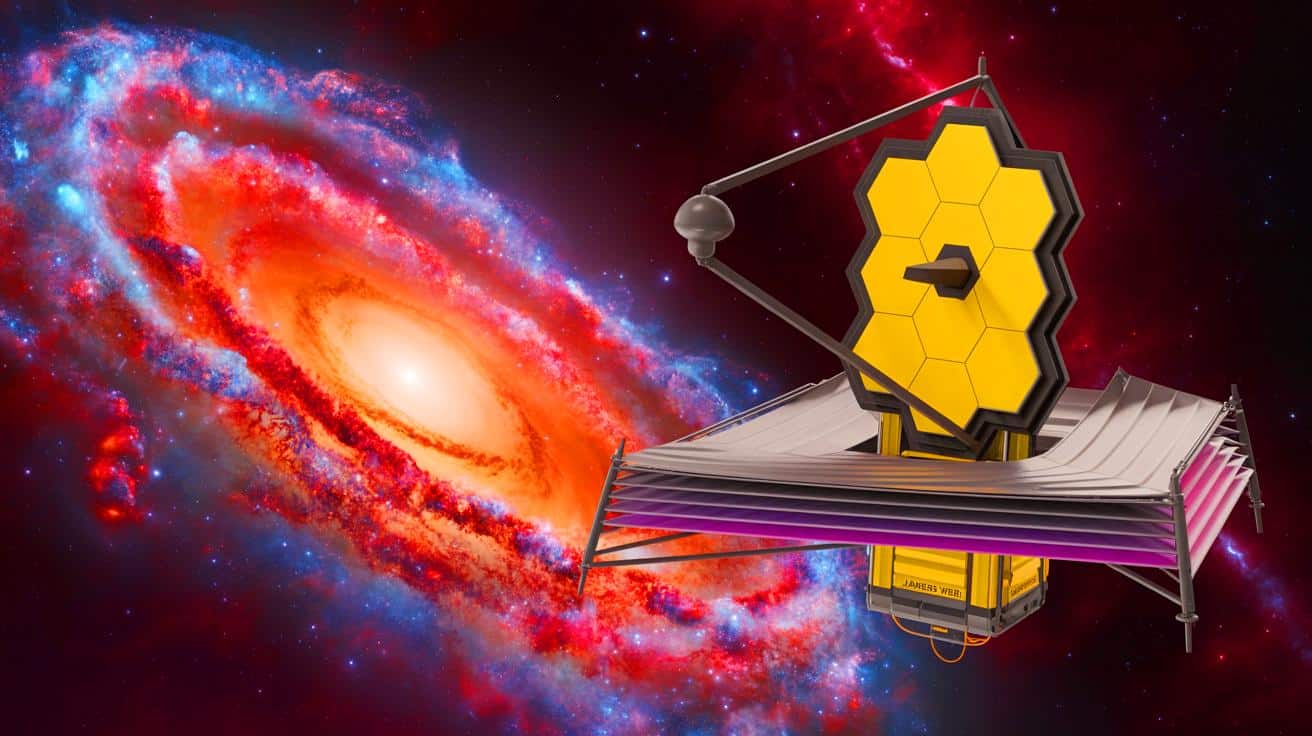
The James Webb Space Telescope has once again opened up new vistas of exploration, potentially solving longstanding cosmic mysteries. Recent data from Webb may unravel the enigma of “The Cliff,” a compact, distant object that challenges our understanding of the early universe. Previously believed to be ancient galaxies, these “little red dots” might instead be supermassive black holes cloaked in hot hydrogen gas. This discovery introduces the concept of the “black hole star,” or BH*, and could shift paradigms in how we perceive the formation of cosmic structures.
The Dots That Didn’t Fit the Script
In the summer of 2022, the James Webb Space Telescope began its scientific observations, revealing scores of small crimson dots in infrared images. These dots glowed at wavelengths unattainable by the Hubble Space Telescope. The light from these sources has journeyed for approximately 12 billion years, allowing scientists to see them as they were a mere 1.8 billion years after the Big Bang. Initially, these dots were interpreted as dust-enshrouded galaxies teeming with stars.
This interpretation posed significant challenges. The density required to fit hundreds of thousands of stars into a space of just a light-year wide was unprecedented. Such density would have made these regions far more compact than any known part of the Milky Way. This conceptualization strained existing models of galactic growth, as it suggested rapid star formation on a scale previously unimagined. Some scientists proposed that these dots could be active galactic nuclei, the luminous centers of galaxies where material spirals into a central black hole.
However, this explanation also faced scrutiny. The spectral data did not align with known characteristics of dust-reddened active galactic nuclei. Moreover, the implied black hole masses seemed implausibly high when considered collectively.
A Survey Finds the Sharpest “Cliff” Yet
An international research team, led by Anna de Graaff from the Max Planck Institute for Astronomy, sought to resolve this mystery by securing nearly 60 hours of observation time with Webb. Their project, known as the Red Unknowns: Bright Infrared Extragalactic Survey (RUBIES), focused on 4,500 distant galaxies, flagging 35 of these enigmatic red dots for detailed analysis. Among them was an extraordinary source, nicknamed “The Cliff.”
The Cliff’s spectrum was revealed to have a dramatic Balmer break, a steep increase in brightness associated with hydrogen atoms. Over billions of years, cosmic expansion has stretched this ultraviolet feature into the near-infrared spectrum, which Webb is designed to observe. While Balmer breaks are common in galaxies where star formation has slowed, The Cliff’s break was far steeper than could be explained by ordinary galactic processes.
The Cliff’s unique characteristics have prompted scientists to reevaluate existing models. Its spectrum suggested a single star’s atmosphere rather than the integrated light of a galaxy. This led researchers to consider the BH* hypothesis: a supermassive black hole surrounded by a dense hydrogen gas envelope.
Models That Miss and One That Matches
De Graaff’s team tested several traditional models to understand The Cliff’s spectrum. They examined galaxy models with extreme star formation, high dust content, and unusual star birth patterns. They also explored active galactic nucleus models dimmed by dust. None of these approaches could account for The Cliff’s distinct spectral features. This challenge forced the team to innovate, developing entirely new models to explain their observations.
One critical clue emerged. The Cliff’s spectrum resembled that of a single star rather than a galaxy. This observation led the researchers to propose the BH* model, whereby a supermassive black hole is encased within a dense hydrogen envelope. This model suggests that the black hole’s radiation heats the surrounding gas similarly to how a star’s core warms its outer layers. In this scenario, there is no nuclear fusion at the core, but the surrounding hydrogen gas takes on a star-like behavior.
The BH* model provided a much better fit for The Cliff’s spectrum. The dense hydrogen layer not only reddens the light but also shapes the Balmer break in a way that aligns with the observations. This model offers a plausible explanation for The Cliff’s unique properties.
Stress-Testing the Dense Galaxy Hypothesis
Independent analyses have also challenged the notion that The Cliff represents an extremely dense galaxy. Stellar models suggested an implausibly high concentration of stars within a compact region. Such density would lead to frequent stellar collisions, generating X-rays that telescopes have not detected from The Cliff. Additionally, Webb’s spectra showed broad hydrogen emission and helium features but lacked the metal lines expected of mature stellar populations.
The absence of metal lines supports the idea of a powerful ionizing source embedded in simple hydrogen gas, rather than a tightly packed star cluster. This further undermines the dense galaxy hypothesis. The red color of The Cliff is not solely due to dust, suggesting an intrinsic redder continuum shaped by a thick gas envelope surrounding a central engine.
This central engine could be a supermassive black hole accreting matter at rates faster than previously considered possible. If BH* systems are common among these little red dots, it may provide insights into how massive black holes formed in the early universe.
Implications for Early Galaxy Growth
The potential existence of BH* objects among these little red dots necessitates a reevaluation of early galaxy formation theories. If many of these red sources are indeed powered by black holes rather than dense star clusters, it could ease the tension with existing galaxy formation models. It also suggests a new pathway for rapid black hole growth, with dense gas both feeding and concealing the core.
The results of this study have been accepted for publication in Astronomy & Astrophysics. Anna de Graaff’s team has focused on The Cliff and the BH* model, while a companion study led by Raphael E. Hviding presents the broader sample of little red dots from the RUBIES survey. The research team includes collaborators from the Max Planck Institute for Astronomy, the Cosmic Dawn Center, Princeton University, Swinburne University, MIT, and Penn State University.
What Comes Next
Future observations with the James Webb Space Telescope will target The Cliff and other promising candidates. These observations will involve deeper spectral analyses across a wider range of wavelengths, along with sensitive X-ray measurements. The goal is to test the predictions of the BH* model and explore how these gas envelopes form and persist. Key questions remain, such as how these envelopes are replenished and how light from the host galaxy interacts with the BH* emission.
For now, The Cliff serves as a benchmark for understanding these phenomena. Its sharp spectral features and lack of metal lines point to a hidden engine at work. This discovery challenges previous assumptions about early galaxy formation and highlights the need for further exploration.
As we continue to uncover the mysteries of the universe, how will our understanding of early cosmic structures evolve, and what new discoveries await us beyond the horizon of our current knowledge?