



| IN A NUTSHELL |
|
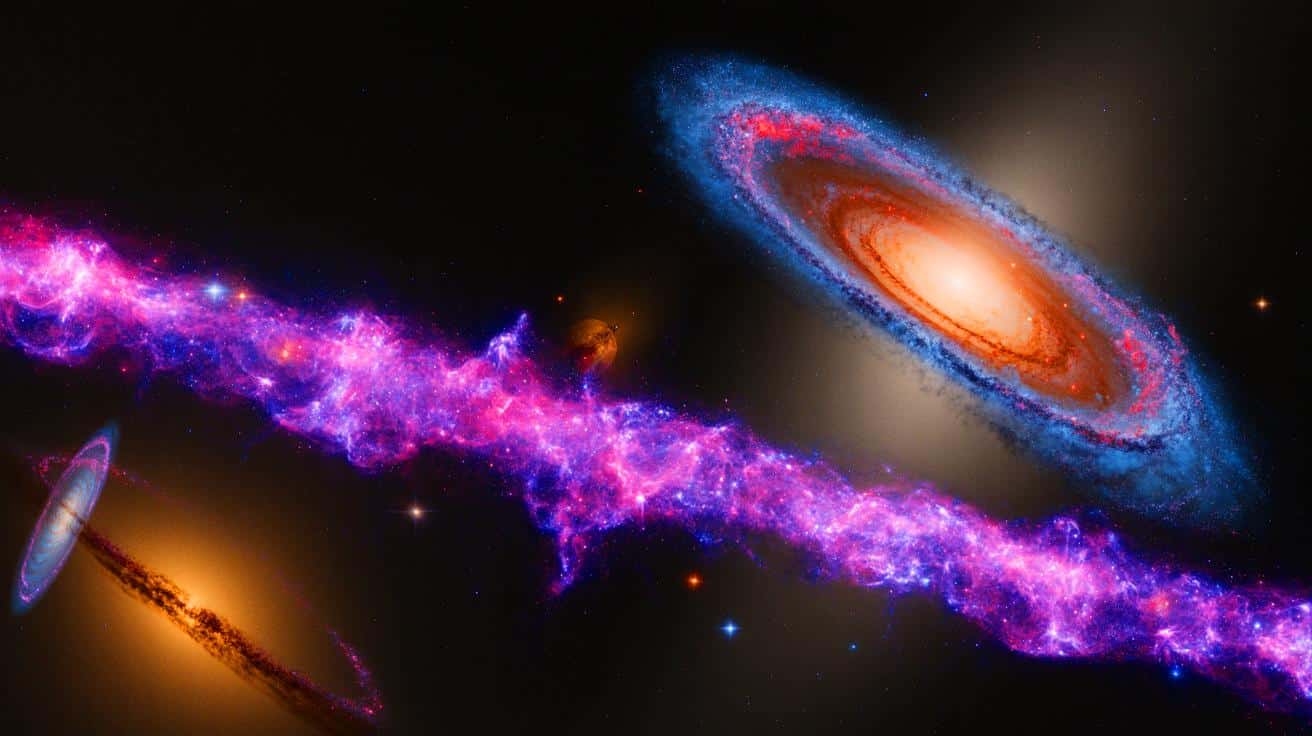
An extraordinary discovery by Australian astronomers has revealed a massive strand of hydrogen gas stretching across 53 million light-years between two dwarf galaxies. This cosmic bridge, as described in a study published in the Monthly Notices of the Royal Astronomical Society, provides new insights into the mechanisms driving galactic evolution. The International Centre for Radio Astronomy Research (ICRAR) at the University of Western Australia (UWA) made this breakthrough while studying the NGC 4532 and DDO 137 galaxies. The hydrogen bridge, measuring an astonishing 185,000 light-years in length, offers a glimpse into the complex interactions occurring in our universe.
Mapping the Cosmos
The discovery is part of the Widefield ASKAP L-band Legacy All-sky Survey, or “WALLABY,” which aims to map the sky and understand the distribution of hydrogen gas between galaxies. This project is pivotal in revealing the large-scale structure of the universe and the role of hydrogen in galactic interactions. Data for WALLABY comes from the Australian Square Kilometre Array Pathfinder (ASKAP) radio telescope, located at the CSIRO Murchison Radio-astronomy Observatory.
The ASKAP telescope, situated in a radio-quiet zone, ensures high-quality observations by minimizing local interference. It is operated by CSIRO, Australia’s national science agency, which supports various research initiatives. The telescope’s observations are crucial for understanding the impact of stellar and black hole feedback on hydrogen gas distribution. These insights could potentially transform our comprehension of how galaxies form and evolve over time.
Discovering a Galactic Bridge
Through the WALLABY project, researchers at ICRAR UWA examined high-resolution observations of neutral hydrogen, identifying significant gas formations in space. Neutral hydrogen is fundamental to star formation, making its study essential for understanding galactic evolution. The researchers found that tidal forces between the NGC 4532 and DDO 137 galaxies, combined with their movement toward the Virgo cluster, are responsible for the unusual gas dynamics observed.
As these galaxies rotated and moved toward the hot gas cloud surrounding the Virgo cluster, they experienced a process known as ram pressure stripping. This phenomenon, described by lead author Professor Lister Staveley-Smith, is akin to the atmospheric burn-up experienced by satellites re-entering Earth’s atmosphere but occurs over a billion years. The density of electrons and the speed of the galaxies’ fall into the hot gas cloud drive this stripping process, creating the hydrogen bridge.
Dwarf Galaxies and the Local Group
The discovery of the hydrogen bridge contributes to a broader understanding of the universe’s most massive structures and their life cycles. By studying these gas bridges, scientists can gain critical insights into how galaxies evolve, how galactic gas is redistributed, and under what conditions galaxies form stars. This discovery is particularly relevant for our understanding of the Local Group, which includes the Milky Way and its satellite galaxies.
Professor Staveley-Smith notes that the connection between NGC 4532 and DDO 137 resembles the Magellanic System, composed of two irregular dwarf galaxies orbiting the Milky Way. This similarity offers a unique opportunity to study the processes that shape our cosmic neighborhood. Ongoing research will continue to refine our understanding of galactic evolution and the forces driving these interactions.
Implications for Galactic Evolution
The WALLABY project’s findings have significant implications for our understanding of the universe. They offer a new perspective on how galaxies interact and evolve, particularly in dense environments. By exploring the dynamics of gas bridges, scientists can better understand the conditions under which galaxies may or may not form stars. This research also sheds light on the history of star formation and the complex processes that govern galactic evolution.
Future studies will likely focus on the detailed dynamics of these gas bridges and their impact on surrounding galaxies. As researchers continue to unravel the mysteries of the universe, the knowledge gained from projects like WALLABY will be crucial in advancing our understanding of cosmic evolution. These efforts underscore the importance of international collaboration and cutting-edge technology in exploring the universe’s vast complexities.
As the study of hydrogen bridges and galactic interactions continues to evolve, scientists are left with intriguing questions about the future of our universe. What other hidden structures might await discovery, and how will they reshape our understanding of cosmic evolution?