



| IN A NUTSHELL |
|
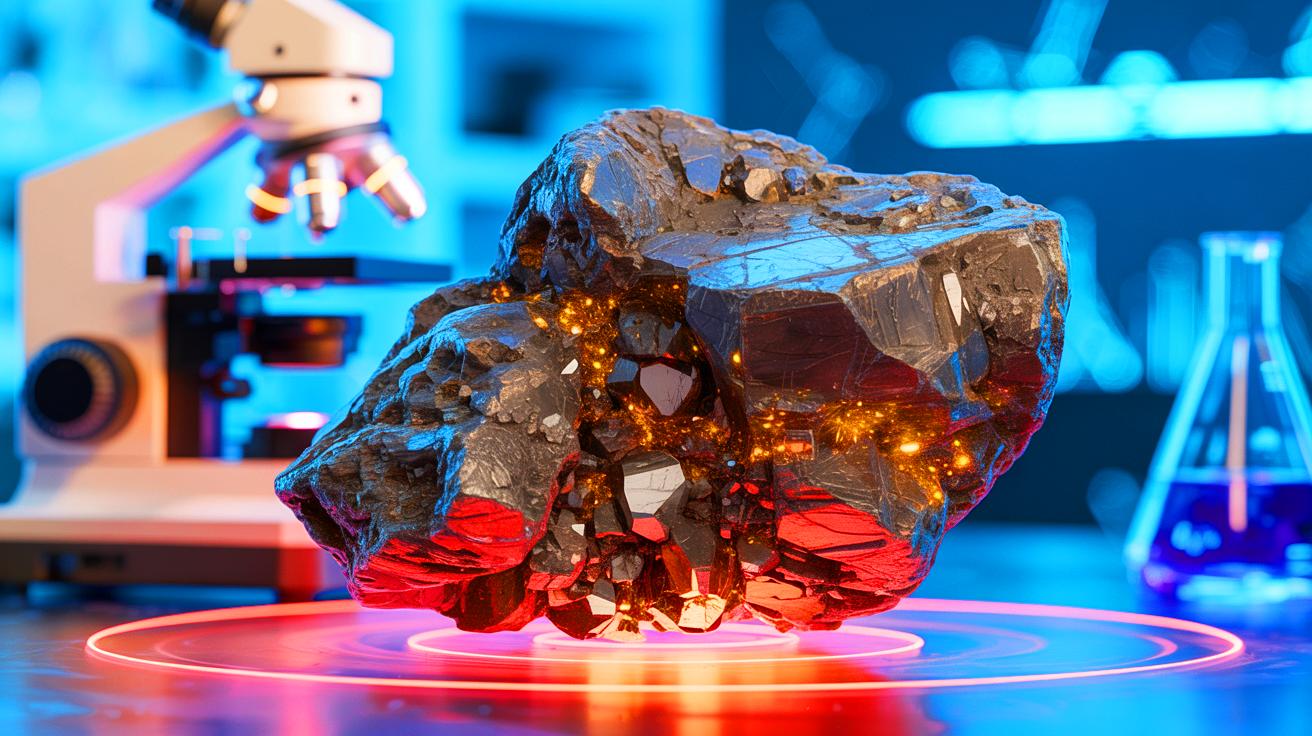
An ancient meteorite, which crash-landed in Germany nearly three centuries ago, is reshaping our understanding of thermal conductivity. A sample from the Steinbach meteorite, discovered in 1724, contains tridymite, a rare form of silica, that defies conventional rules about how solids conduct heat. Typically, crystalline structures become less efficient at conducting heat as temperatures rise, while glasses improve their conductivity. However, this piece of tridymite remains remarkably stable, maintaining its ability to conduct heat across various temperatures. This anomaly not only challenges long-held scientific beliefs but also has the potential to revolutionize the way we manage heat in numerous applications.
Bridging Crystals and Glasses
Heat movement in solids generally follows predictable patterns. In crystalline structures, heat transfers through an orderly atomic grid, while in glasses, heat behaves more erratically, flowing in wave-like patterns. These different mechanisms typically lead to contrasting reactions to temperature changes. However, tridymite from the Steinbach meteorite presents an intriguing exception to these rules.
The tridymite is structurally akin to a crystal but resembles glass in form. This unique arrangement allows it to facilitate both particle-like and wave-like heat transfers simultaneously. As a result, these opposing effects balance each other out, enabling the material to maintain stable thermal conductivity even as temperatures fluctuate. This phenomenon has been observed both at high temperatures and within the quantum regime, a domain where particles exhibit wave-like behavior, further challenging established notions of thermal dynamics.
The unexpected thermal stability of tridymite opens new avenues for controlling heat transfer in innovative ways.
The Equation That Started It All
The foundation for this groundbreaking discovery was laid in 2019 by researchers Michele Simoncelli, Nicola Marzari, and Francesco Mauri. They developed a comprehensive equation to model heat flow in both crystals and glasses, unifying these distinct behaviors into a singular framework.
Their research focused on silicon dioxide, a prevalent substance found in materials like sand and quartz. Tridymite, a special form of silicon dioxide, intrigued the team due to its potential hybrid properties. Their calculations suggested that tridymite could exhibit thermal conductivity unaffected by temperature, a rare trait reminiscent of the “invar effect,” where certain metals resist expansion upon heating. This characteristic, recognized with a Nobel Prize in 1920, hinted at the possibility of discovering new materials with equally extraordinary thermal properties.
Testing a 300-Year-Old Meteorite
To validate their hypothesis, Simoncelli’s team collaborated with experts in France to analyze the Steinbach meteorite, housed in Paris’s National Museum of Natural History. Researchers carefully extracted a tridymite sample, revealing an atomic structure that defied simple classification as either crystal or glass.
Testing confirmed that the material’s thermal conductivity remained remarkably constant between 80 and 380 Kelvin, ranging from temperatures colder than dry ice to hotter than boiling water. This stability over such a wide temperature range is unprecedented in solids, marking a significant breakthrough in thermal conductivity research.
Impacts Beyond the Lab
The implications of this discovery stretch far beyond academic circles. Understanding and leveraging stable thermal conductivity could lead to significant advancements in energy efficiency and emission reduction. For instance, the steel industry, a major carbon emitter, could benefit immensely. Steel production, responsible for about 7% of U.S. emissions, could become more sustainable by adopting materials with hybrid crystal-glass structures.
Such materials can form naturally in the high-temperature environments of steel furnace bricks, mirroring the meteorite’s unique properties. By optimizing these materials for industrial use, companies could enhance heat management, minimize energy waste, and lessen their environmental impact, potentially heralding a new era of greener industrial practices.
The Steinbach meteorite’s properties could pave the way for cleaner, more efficient industry practices.
Harnessing AI to Explore Quantum Materials
Beyond heat conductivity, Simoncelli’s research explores broader applications, using machine learning to simulate atomic behavior. This approach accelerates predictions about how various forces, including heat and electricity, traverse solids.
Traditional methods of resolving quantum equations are often too slow for large-scale applications. However, integrating artificial intelligence streamlines this process, maintaining precision while enhancing efficiency. This methodology is crucial for identifying materials ideal for converting heat into electricity, cooling electronics, or even creating neuromorphic devices that emulate neural functions.
The potential applications are vast, ranging from wearable technology to quantum computing. By merging AI with quantum physics, Simoncelli’s group not only advances theoretical understanding but also provides practical solutions for industrial challenges, marking a pivotal shift in materials science research.
The discovery of tridymite’s unique thermal properties has rewritten the rules of heat management. By revealing how hybrid materials can maintain stable conductivity across temperatures, this research challenges the dichotomy between crystals and glasses. As industries seek to enhance efficiency and environmental sustainability, could these findings catalyze a broader adoption of hybrid materials, reshaping the future of technology and energy? The possibilities seem as boundless as the universe from which this meteorite originated.