



| IN A NUTSHELL |
|
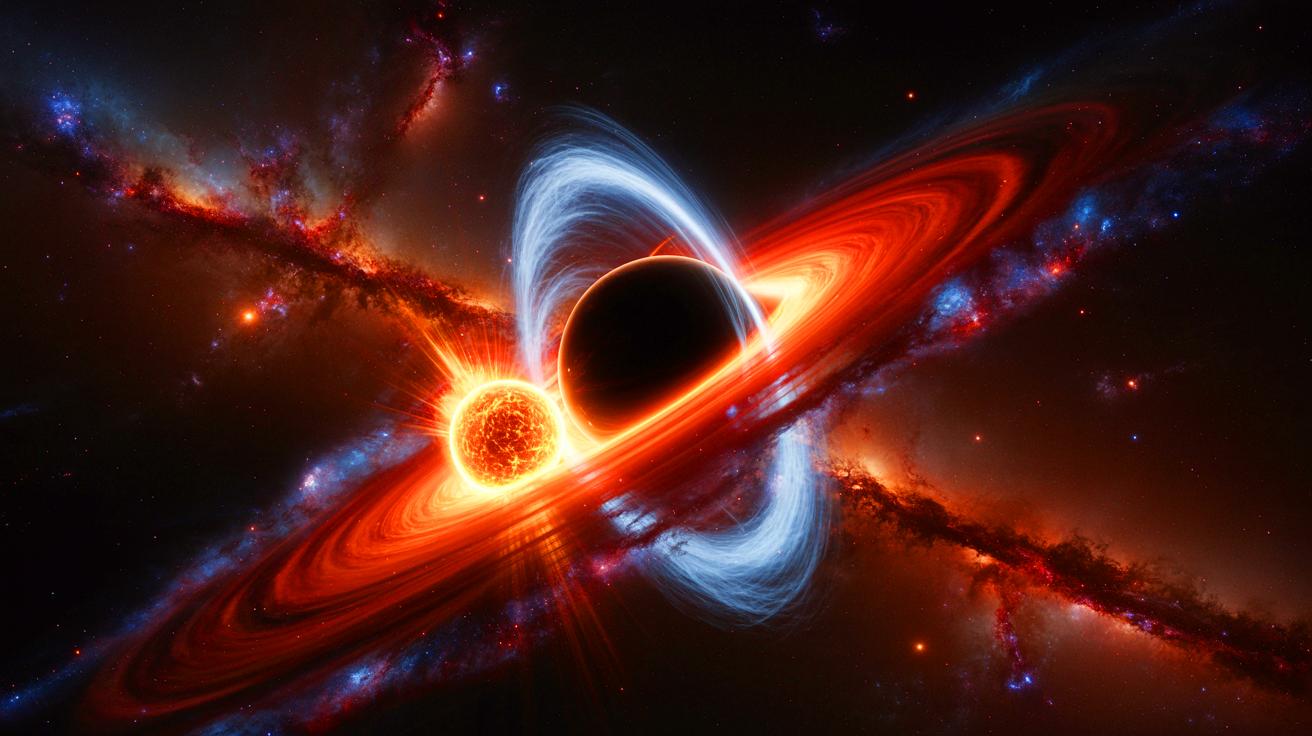
In a groundbreaking discovery that challenges long-held beliefs about the universe, astronomers have observed a black hole tearing apart a star at an unexpected location. Traditionally, such events, known as tidal disruption events (TDEs), occur at the center of galaxies where supermassive black holes reside. However, this particular event, designated AT 2024tvd, was detected far from the galactic nucleus. This discovery not only alters our understanding of black holes but also provides a new perspective on their behavior and positioning within galaxies.
A Black Hole Out of Place
AT 2024tvd was first identified by the Zwicky Transient Facility, which monitors the night sky for sudden changes in brightness. Initial observations suggested the event was occurring near a galaxy’s core. However, upon closer examination, astronomers discovered that the source was located approximately 2,600 light-years away from the center, making it “off-nuclear.” This is a significant anomaly, as most supermassive black holes are stationary at the galaxy’s center, where they exert gravitational control.
The unexpected location of this black hole has intrigued scientists. Dr. Itai Sfaradi of the University of California, Berkeley, expressed his amazement, noting the unprecedented nature of the radio emissions observed. “We never before witnessed such strong radio emission from a black hole tearing apart a star outside a galaxy’s core,” he stated. This discovery has prompted a reevaluation of black hole behavior, challenging existing theories and opening new avenues for research.
Chasing the Signal
The pursuit of this phenomenon involved some of the world’s most advanced radio telescopes, including the Very Large Array in New Mexico and the Atacama Large Millimeter/submillimeter Array in Chile. These instruments captured two distinct radio spikes of brightness, with the first occurring 131 days after discovery and the second around 194 days later. The rapid evolution of these radio signals set AT 2024tvd apart as the most rapidly evolving radio TDE ever recorded.
Such rapid changes in the radio band are rare, revealing the powerful and dynamic nature of the outflows from the black hole. Prof. Assaf Horesh from the Hebrew University of Jerusalem highlighted the significance of these observations, noting that they provide new insights into how black holes interact with their environment. The data suggest that the outflows were not only powerful but also evolved in a previously unobserved manner.
Two Explosive Outbursts or One Complicated One?
The dual-peaked radio signature of AT 2024tvd has sparked debate among scientists. Was it a single ejection of material interacting with ambient gas twice, or were there two separate outbursts? Some researchers favor the latter theory, suggesting that the black hole experienced two distinct ejection events. This implies a complex feeding process, with the black hole “awakening” after a period of inactivity to release new streams of matter.
Computer simulations support both possibilities, but the observed radio patterns remain difficult to explain with a single outflow. The consideration of absorption and cooling processes, which could affect the evolution of the signals, adds further complexity. Despite these challenges, the discovery has prompted a reevaluation of how black holes consume and eject matter, indicating a more unstable and episodic feeding pattern than previously thought.
A Record-Breaking Event
AT 2024tvd stands out for several reasons, including its unusual location and the rapid evolution of its radio signals. The event’s position far from the galactic center suggests that some black holes may drift through galaxies after being displaced from their original orbits, potentially due to galactic mergers. This challenges the assumption that supermassive black holes are always anchored at the heart of galaxies.
Additionally, the exceptional speed at which the radio signals evolved exceeds any previously recorded TDE, introducing new complexity to the study of black hole outflows. The second flare being more luminous than the first is particularly rare, suggesting that multiple or repeated ejections of material may occur. This finding complicates existing models, which typically predict a single burst of energy following a star’s destruction.
Radio Waves and X-Rays in Concert
The initial radio burst of AT 2024tvd was followed by a new X-ray emission, presenting a unique opportunity to study the relationship between these two types of radiation. The X-ray radiation exhibited a power-law spectrum typical of inverse Compton scattering, where high-energy electrons interact with low-frequency photons. This suggests a connection between the X-ray-producing area near the black hole and the more distant radio-emitting outflows.
This discovery has significant implications for understanding the processes that occur when black holes consume stars. It demonstrates that black holes can exist and feed far from the centers of galaxies, challenging existing models of their behavior. The phenomenon also suggests that black hole outflows may occur in multiple stages, with individual bursts of energy and radio light, rather than a single, massive explosion.
The observation of AT 2024tvd offers a new perspective on black holes and their interactions with the universe. By demonstrating that black holes can exist outside the centers of galaxies and exhibit complex feeding patterns, this discovery challenges existing theories and opens new avenues for research. As astronomers continue to explore these enigmatic objects, they will undoubtedly uncover more surprises that will reshape our understanding of the cosmos. What other mysteries might black holes hold that we have yet to discover?