



| IN A NUTSHELL |
|
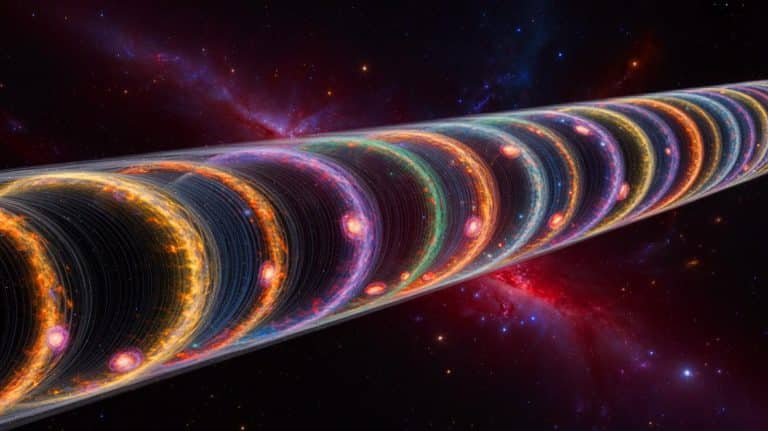
In a groundbreaking discovery, citizen scientists have identified three enormous radio light rings located far beyond our galaxy. These findings were made by the RAD@home Astronomy Collaboratory, a community combining professional astronomers and amateur volunteers. The newly discovered structures, known as Odd Radio Circles (ORCs), challenge existing astronomical theories. Unlike traditional radio galaxies, which emit focused beams from black holes, these rings appear as vast, faint emissions that are nearly undetectable with standard telescopes. The ORCs’ discovery highlights the power of collaborative science, as well as the ongoing mysteries of the universe, warranting further investigation into their origins and implications for cosmic evolution.
A New Cosmic Mystery
Odd Radio Circles, or ORCs, are a recent astronomical phenomenon that has puzzled scientists since their initial discovery in 2019. Unlike typical radio sources, which are galaxies emitting twin jets of charged particles, ORCs manifest as enormous rings of radio emissions. These structures can extend hundreds of thousands of light-years, dwarfing the Milky Way by ten to twenty times. This discovery raises questions about their formation, with theories ranging from collisions between black holes to colossal particle flows known as “superwinds.”
Among the newly found ORCs, RAD J131346.9+500320 stands out. Situated nearly halfway across the universe, its light began its journey when the universe was half its current age. This ORC is the most luminous ever detected, shining nearly a hundred times brighter than similar structures. Such characteristics make ORCs rare and dim, visible only in radio light. This discovery underscores the need for more research to understand these enigmatic cosmic features better.
Two Rings That Intersect
A unique aspect of RAD J131346.9+500320 is its double-ring structure, intersecting at an impressive 800,000 light-years across. Such formations are incredibly rare, with only one other known instance. The radio emission from these rings decreases with higher frequencies, indicating they consist of aging plasma. This plasma is likely a remnant of a significant cosmic event from the distant past.
To uncover these details, astronomers utilized the Low-Frequency Array (LOFAR), a vast network of antennas across Europe. Operating at frequencies between 10 and 240 megahertz, LOFAR can detect faint radio waves from billions of years ago, offering a window into the early universe. This technology, combined with citizen science efforts, has expanded our understanding of cosmic evolution and the potential interactions between galaxies and black holes.
Rings Born of Bent Jets
The other two ORC discoveries are equally fascinating. One, named RAD J122622.6+640622, is a massive radio galaxy spanning nearly three million light-years. Its jet unexpectedly bends into a near-circle about 100,000 light-years in diameter. This deflection could result from the jet colliding with dense material or pressure gradients within its host cluster, creating a radio loop. Located on the galaxy cluster’s outskirts, the ring’s shape is likely influenced by environmental forces.
The third discovery, RAD J142004.0+621715, features a thin jet ending in a bright radio emission ring on the galaxy’s edge. The structure, approximately 1.4 million light-years wide, sits at the core of a giant galaxy cluster. The ring, about 60,000 light-years wide, glows where the jet interacts with the cluster’s hot plasma. This interaction suggests the cluster environment shapes the ring and jet, highlighting the complex dynamics of cosmic structures.
The Role of Citizen Science
The discoveries of these radio rings were made possible through the efforts of the RAD@home Astronomy Collaboratory, an online community of students, researchers, and volunteers. This group analyzes publicly available radio sky surveys, using their home computers to identify patterns that automated algorithms might overlook. Citizen scientists have proven particularly adept at spotting peculiar features like ORCs, which are often ignored by programs due to their thinness.
Dr. Pratik Dabhade of Poland’s National Centre for Nuclear Research emphasized the significance of these findings. “Citizen scientists are still undefeated at finding peculiar patterns,” he said. The collaboration between amateur and professional astronomers has set a new standard for exploring challenging data, demonstrating the potential of citizen science in advancing astronomical research.
Clues to Galactic Evolution
The environment in which these ORCs are found offers vital clues about their formation. All three reside within densely packed galaxy clusters, containing around 100 trillion solar masses of material. This suggests that the hot plasma surrounding these rings plays a significant role in their development. The radio emission likely results from relativistic electrons traversing magnetic fields in a synchrotron radiation process.
The upcoming generation of radio telescopes, such as the Square Kilometre Array, promises to be more sensitive, potentially revealing thousands more ORCs. New optical surveys, including the Vera C. Rubin Observatory and DESI, will help researchers match these radio rings with their parent galaxies. Such advancements will enable a deeper exploration of how these structures evolve over cosmic time, offering new insights into the universe’s mysteries.
The discovery of these Odd Radio Circles opens a new chapter in radio astronomy, highlighting the universe’s hidden complexities. These findings demonstrate the potential of citizen science in unraveling cosmic enigmas and emphasize the importance of collaboration in scientific discovery. As astronomers continue to explore these mysterious structures, what new revelations about the universe’s evolution and the forces shaping galaxies can we expect in the future?