



| IN A NUTSHELL |
|
For years, scientists have been intrigued by a peculiar signal detected on Mars, one that didn’t correspond to any known mineral. This enigmatic signal has now been identified as ferric hydroxysulfate, a groundbreaking discovery that could alter our understanding of Mars’ geological history and potential habitability. The finding suggests that Mars may have experienced more dynamic and complex environmental changes than previously thought, possibly involving volcanic or geothermal activity. This revelation not only reshapes our view of the Red Planet’s past but also guides future explorations in search of life-supporting conditions.
Chasing a Signal No One Could Place
More than a decade ago, the Compact Reconnaissance Imaging Spectrometer for Mars (CRISM) identified an unusual light absorption band at 2.236 micrometers. This signal was observed in regions like Aram Chaos and the Juventae Plateau, yet no known minerals, such as jarosite, gypsum, or clays, matched this spectral signature. Janice Bishop, a senior research scientist at the SETI Institute and NASA Ames Research Center, noted, “It just didn’t look like anything we’d cataloged before.”
Unraveling the mystery required advanced techniques to interpret the data. Light from the Sun, after reflecting off Mars’ surface, interacts with the thin Martian atmosphere, complicating the data captured by CRISM. Mario Parente, an associate professor at the University of Massachusetts Amherst, explained that the raw data was distorted by atmospheric molecules and gases like carbon dioxide. His team used deep learning algorithms to correct these distortions, providing a clearer image of the mysterious signal.
Building Mars in the Lab
With a clearer spectral signature, researchers turned to laboratory experiments to replicate the conditions on Mars. By heating hydrated ferrous sulfate minerals, such as rozenite and szomolnokite, under controlled conditions, they successfully produced ferric hydroxysulfate. The transformation hinged on the presence of oxygen. Experiments showed that samples exposed to air at 100 degrees Celsius converted into ferric hydroxysulfate within six days, while those in a nitrogen environment did not.
This newly formed mineral, likely due to its unique crystal structure and thermal stability, awaits official recognition. As Bishop remarked, “The material formed in these lab experiments is likely a new mineral.” However, to qualify as a new mineral, it must also be discovered on Earth. These findings underscore the complexity of Mars’ geochemical processes and highlight the role of oxygen in mineral transformations.
Where the Mineral Lives on Mars
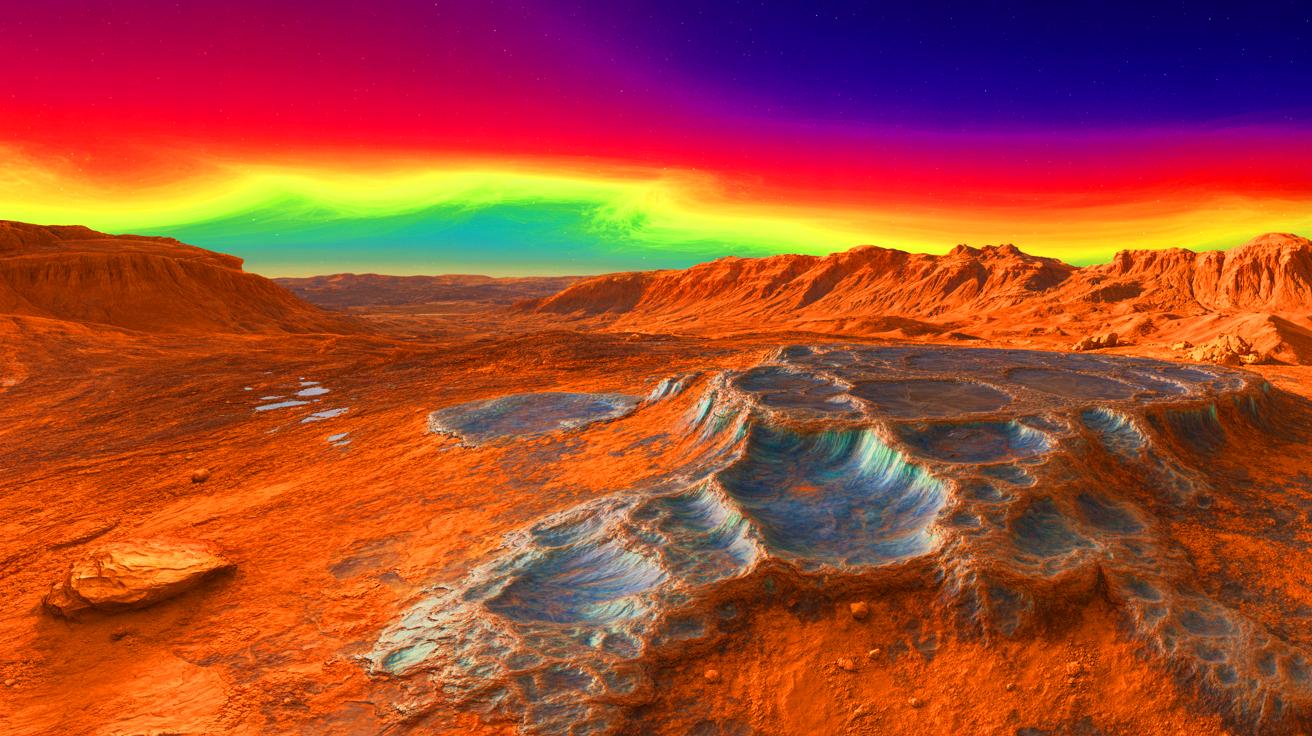
Mapping the distribution of ferric hydroxysulfate on Mars revealed its presence in specific geological contexts. On the Juventae Plateau, the mineral appears as thin layers between older basalt flows and hydrated sulfates. Volcanic ash or lava heat is believed to have triggered the transformation of sulfates. In contrast, at Aram Chaos, ferric hydroxysulfate is found deeper, near the base of sulfate-rich layers, suggesting that geothermal heat from below catalyzed its formation.
These findings indicate a more chemically active Martian crust than previously assumed. The association of ferric hydroxysulfate with other hydrated sulfates suggests that Mars experienced significant geothermal or volcanic activity, leading to mineral transformations. This dynamic geological history opens new avenues for understanding the planet’s evolution and its potential to support life.
What It Reveals About Mars’ History
The discovery of ferric hydroxysulfate provides new insights into Mars’ environmental history. Traditionally, Martian sulfates were attributed to cold, evaporating water. However, this mineral points to a different pathway involving heat from volcanism or underground geothermal energy. “Temperature, pressure, and conditions such as pH are all very important indications of what the paleoclimate was,” noted Parente. The presence of this mineral adds nuance to our understanding of Mars’ past climate and geological processes.
Researchers suggest that these transformations likely occurred less than 3 billion years ago during the Amazonian period. This indicates that Mars remained chemically and thermally active more recently than once believed. Such activity holds implications for the planet’s habitability and provides clues about its potential to sustain life in the past.
Practical Implications of the Research
Identifying ferric hydroxysulfate enhances our understanding of how heat and water have shaped Mars’ surface. This discovery suggests that Mars’ environment was dynamic and continued to evolve long after the planet lost most of its atmosphere. The mineral serves as a marker for areas where volcanic or geothermal energy interacted with water, potentially creating conditions favorable for life.
Future missions could target these sites to search for preserved organic molecules or other signs of habitability. As sample return missions advance, ferric hydroxysulfate may guide scientists in selecting promising excavation sites. Additionally, the research refines techniques for interpreting mineral signatures in planetary data, benefiting Earth-based studies as well.
“The material formed in these lab experiments is likely a new mineral due to its unique crystal structure and thermal stability.”, Janice Bishop
The discovery of ferric hydroxysulfate on Mars opens new chapters in our understanding of the planet’s geological and environmental history. As scientists continue to explore the implications of this finding, it raises intriguing questions about the potential for past or present life on Mars. What other secrets might Mars hold, waiting to be uncovered by future explorations?