



| IN A NUTSHELL |
|
In the vast timeline of the universe, the formation of our Solar System and Earth itself represents a fleeting moment. Approximately 4.6 billion years ago, a cloud of dust and gas coalesced under the force of gravity, giving birth to the Sun and its planetary companions. Recent research from the University of Bern has shed new light on this ancient process, suggesting that Earth’s chemical character was established far earlier than previously believed. Within a mere three million years of the Solar System’s creation, Earth had already formed its chemical identity. Yet, this early Earth was not the blue planet we know today; it was a barren world, devoid of water and the essential ingredients for life, until a cataclysmic collision changed everything.
Timing Earth’s Chemical “Fingerprint”
At the heart of this groundbreaking research is the study of isotopes. Led by Dr. Pascal Kruttasch from Imperial College London, the team focused on the ratio of manganese (Mn) to chromium (Cr) in meteorites and terrestrial rocks. Utilizing the radioactive decay of manganese-53 to chromium-53, which occurs over approximately 3.8 million years, scientists have developed an atomic clock to pinpoint the formation of Earth’s materials.
As Klaus Mezger, Professor Emeritus of Geochemistry at Bern, explains, “These measurements were possible because the University of Bern has world-expertise in the analysis of extraterrestrial materials.” Through this precise isotopic analysis, researchers determined that Earth’s ancestor, the proto-Earth, had acquired its final chemical composition by three million years into the Solar System’s formation. This composition notably lacked volatile elements such as water, carbon, and sulfur, elements crucial for life.
The study’s findings challenge previous assumptions about Earth’s early development, suggesting that the planet’s chemistry was established long before it acquired the materials necessary for life. This discovery prompts a reevaluation of how we understand the timeline of Earth’s evolution and the conditions required for habitability.
A Dry Beginning in a Hot Neighborhood
Earth’s initial dryness can be attributed to the conditions of the inner Solar System, where it formed alongside Venus and Mars. The intense heat in this region prevented volatile compounds from transitioning from gas to solid, leaving these elements out of the building blocks that formed the terrestrial planets.
In contrast, bodies forming farther from the Sun, like the moons of Jupiter and Saturn, managed to retain more water and carbon due to cooler temperatures. By comparing Earth’s isotopic signature to that of meteorites from the outer Solar System, researchers found that the proto-Earth’s chemistry had been stripped of volatiles within its first three million years.
At this early stage, Earth was essentially a barren rock with its chemical personality defined but missing the elements needed for life. This realization highlights the stark contrast between Earth’s initial state and its current form, raising questions about the processes that eventually transformed it into a habitable world.
The Cosmic Collision That Changed Everything
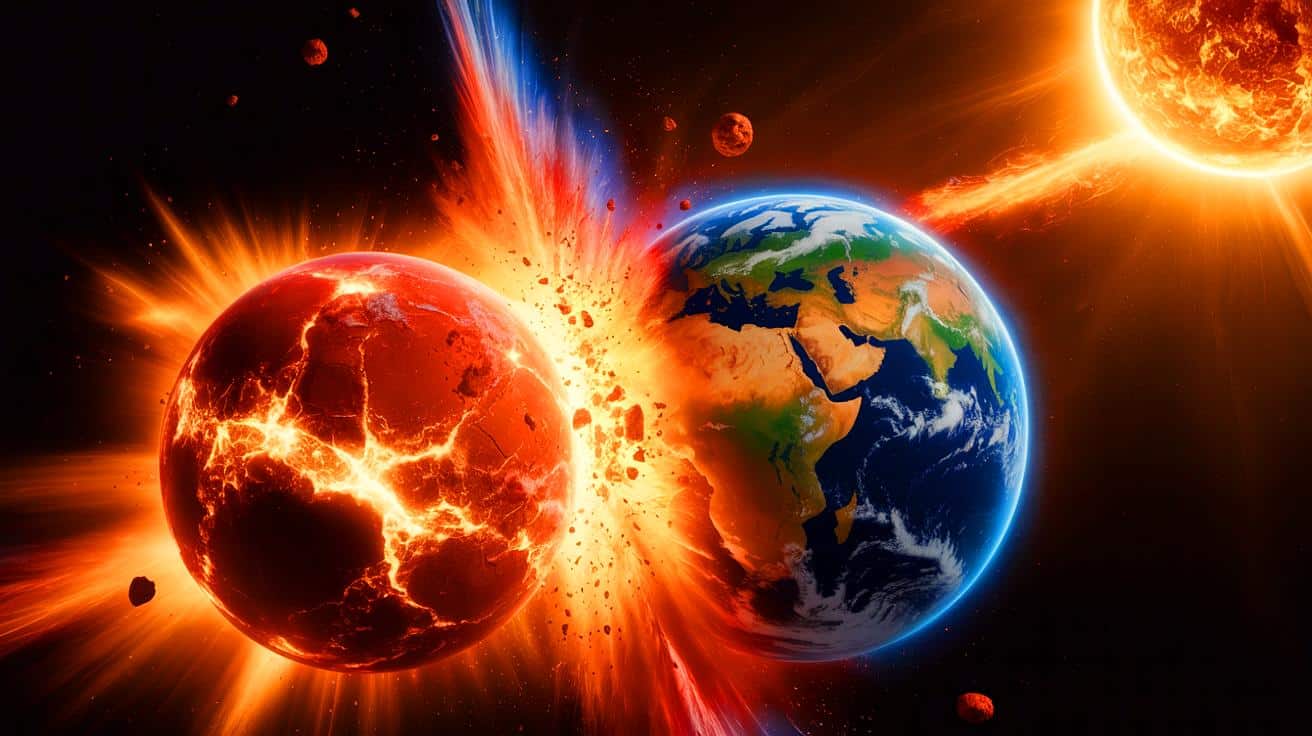
The transformation of Earth from a dry rock to the vibrant planet we inhabit today is attributed to a monumental collision with a Mars-sized body known as Theia. Occurring tens of millions of years after Earth’s formation, this collision is thought to have originated from a cooler region of the Solar System where volatile elements were more abundant.
This cataclysmic event not only had a significant impact on Earth’s composition but also led to the formation of the Moon. Isotope data suggests that Theia’s collision delivered water and other essential elements to Earth’s surface, effectively jumpstarting the conditions necessary for life.
“Because of our results, we’re sure proto-Earth was initially a dry rocky body,” Kruttasch stated. “It can therefore be said that only the collision with Theia supplied volatile elements to Earth and ultimately enabled life.”
The collision with Theia did not redefine Earth’s core composition but provided the missing elements that would eventually fill its oceans and atmosphere. This event underscores the pivotal role of cosmic occurrences in shaping the Earth’s habitability.
A Lucky Twist in the Story of Life
This research underscores the role of chance in Earth’s history. The existence of life as we know it may hinge on a single, violent impact billions of years ago. Without Theia’s collision, Earth might have remained an arid, lifeless world.
As Klaus Mezger remarked, “The Earth’s current friendliness to life is not the result of a continuous evolution but probably the result of an accident, its late impact with an extraterrestrial, water-rich body.” This insight challenges the notion of life’s inevitability and suggests that cosmic luck played a critical role in Earth’s development.
The findings also have implications for the search for life elsewhere in the universe. If Earth-like planets require both rapid early evolution and a volatile-rich collision, life-supporting worlds may be rarer than previously thought. This raises intriguing questions about the conditions necessary for life beyond our planet.
The research from the University of Bern offers a fresh perspective on Earth’s early development and the factors that contributed to its habitability. By revealing the rapid timeline of Earth’s chemical evolution and the critical role of Theia’s collision, it challenges our understanding of planetary formation. As we continue to explore the cosmos, how will this knowledge influence our search for life on other planets? The answers may redefine our place in the universe.