



| IN A NUTSHELL |
|
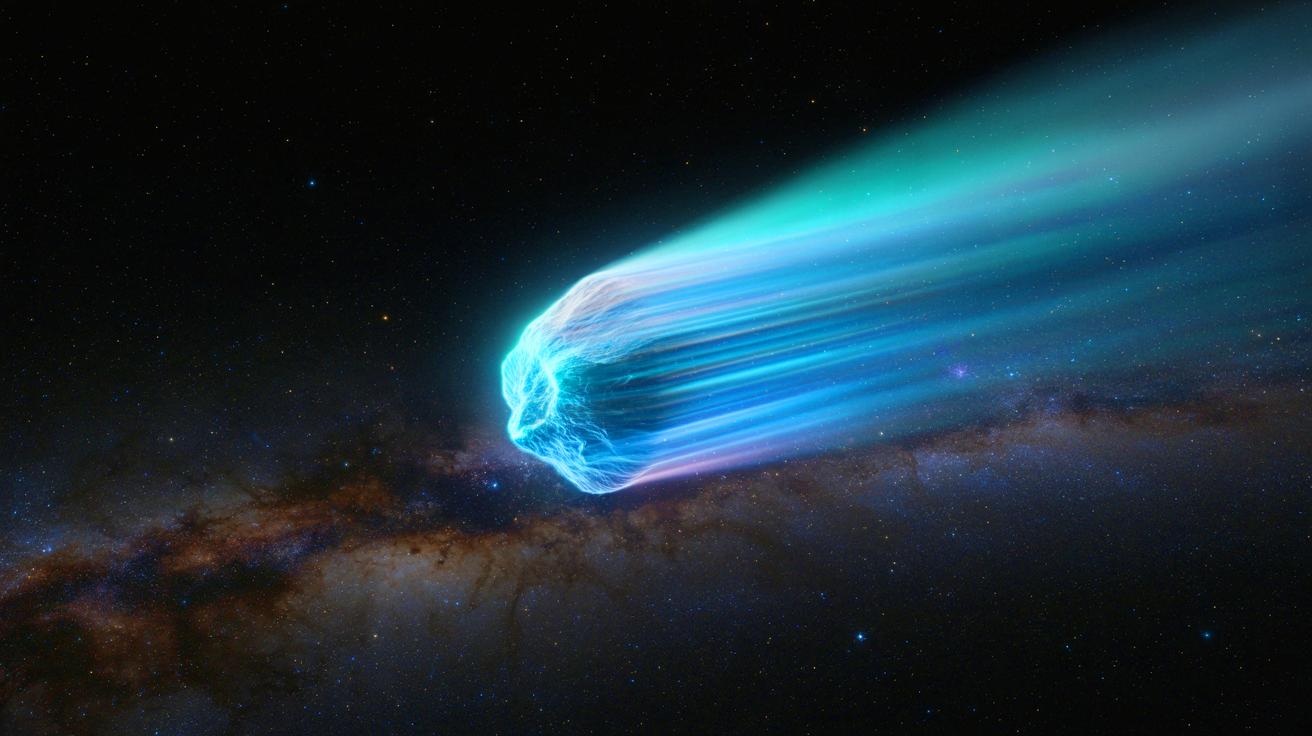
Astronomers have been captivated by a rare celestial visitor, the interstellar comet 3I/ATLAS. Unlike any other object we’ve observed, it has provided new insights into the movement of water and potentially life-sustaining materials across the stars. Discovered as it traveled through our solar system, 3I/ATLAS is only the third known interstellar object, offering a unique opportunity to study materials from beyond our solar neighborhood. Its journey has revealed surprising water activity, challenging our understanding of cometary behavior and hinting at the broader processes at play in the formation of celestial bodies. This discovery could reshape our perceptions of planetary system formation and the potential for life beyond our solar system.
Unveiling Water from the Stars
The discovery of water in 3I/ATLAS is nothing short of revolutionary. Led by astrophysicist Zexi Xing, the team at Auburn University utilized NASA’s Neil Gehrels Swift Observatory to detect ultraviolet emissions indicating water vapor. This finding is remarkable because the comet was nearly three times as far from the Sun as Earth, a distance where most comets would not release water. The comet’s activity defies expectations, suggesting that its water is carried by small ice grains that vaporize in the weak sunlight.
The sheer volume of water being released, about 40 kilograms per second, places 3I/ATLAS in a category of its own. Such distant water sublimation is rare, indicating unique conditions or materials within the comet. These observations suggest that 3I/ATLAS may have a surface rich in ice or is shedding volatile dust grains that continue to evaporate once expelled into space. This activity highlights the potential for water to be transported across vast interstellar distances, potentially seeding other planetary systems with the building blocks of life.
The Ultraviolet Advantage
The use of Swift’s Ultraviolet/Optical Telescope was crucial in this discovery. Unlike ground-based telescopes, Swift can observe ultraviolet light without interference from Earth’s atmosphere. This capability allowed astronomers to capture images of 3I/ATLAS in July and August 2025, revealing a significant increase in water production as the comet approached the Sun.
To capture these images, scientists employed a technique known as motion correction, breaking the data into 30-second intervals to avoid blurring caused by the comet’s movement. By stacking these exposures, they observed a foggy envelope of gas around the comet: a sign of water being released. This innovative approach provided clear evidence of the comet’s water activity, further emphasizing the importance of space-based telescopes in studying celestial phenomena.
Measuring the Flow
Quantifying the water emission from 3I/ATLAS involved several steps. Researchers estimated the number of hydroxyl molecules within a specific radius of the nucleus and calculated the rate at which water molecules break up due to sunlight. This process allowed them to determine the comet’s water production rate accurately.
Adjustments were made for how the comet’s dust scatters sunlight, a factor known as “reddening.” This correction was essential to differentiate between actual chemical emissions and scattered light. The findings revealed that a significant portion of the comet’s surface, over 8%, was actively emitting vapor, a much higher percentage than typical comets in our solar system. This level of activity suggests a surface rich in ice or ongoing release of volatile materials, providing new insights into the composition and behavior of interstellar comets.
Interstellar Visitors Compared
The discovery of water in 3I/ATLAS adds a new chapter to our understanding of interstellar objects. Unlike its predecessors, 1I/’Oumuamua and 2I/Borisov, 3I/ATLAS exhibits intense water activity without significant emissions of other gases. This distinct behavior underscores the diversity of interstellar travelers and their origins.
Infrared observations revealed frozen grains orbiting the comet, suggesting that much of its water comes from suspended material rather than its solid core. By analyzing both infrared and ultraviolet data, scientists confirmed that the emissions were primarily water, not other gases. These findings highlight the varied conditions under which interstellar comets form, reflecting the diverse environments from which they originate. This diversity suggests that planetary systems beyond our own Sun may host comets with unique compositions and histories.
A Window into Planet Formation
The study of 3I/ATLAS offers a glimpse into the processes that shape planetary systems. The comet’s ability to preserve water over long interstellar journeys suggests that such objects could transport essential materials across galaxies. This discovery raises the possibility that comets play a role in delivering the ingredients for life to nascent worlds.
The comet’s unusual chemistry, being water-rich yet cyanogen-poor, indicates it may have formed in a carbon-deprived environment near a young, metal-poor star. Each interstellar comet observed so far has challenged our understanding of planet and comet formation. As 3I/ATLAS continues its journey, astronomers eagerly await further observations to see how its activity evolves as it approaches the Sun.
The findings from 3I/ATLAS have profound implications for our understanding of the cosmos. By demonstrating that interstellar objects can carry water across vast distances, this research offers new perspectives on the potential for life beyond Earth. As scientists continue to study these celestial travelers, new questions arise: What other secrets do interstellar comets hold, and how might they contribute to the formation of life in other parts of the universe?